The humidity of a late Shanghai afternoon hung heavy over the Jing'an district, thick with the scent of fried scallion pancakes and laundry detergent. Leo, a tall American expat with a slightly crumpled map and a dying smartphone, found himself standing at the mouth of a 'longtang'—one of those narrow, maze-like alleyway neighborhoods that feel like a secret world hidden behind the glass skyscrapers.
He was supposed to be at his friend Wei’s house-warming party. The address on his screen read: 'Lane 14, Door 5, Building 2.' But as he looked at the branching paths of grey brick and tangled overhead wires, he felt utterly adrift. He muttered under his breath, staring at the blue dot on his screen that seemed to be spinning in confused circles.
'Where is it?' he sighed. He looked at the screen again, practicing the phrase he knew he’d need soon. 'Nǐ zhù zài nǎ lǐ? Nǐ zhù zài nǎ lǐ?'
Suddenly, a rhythmic 'clack-clack-clack' sound approached. An elderly woman, Mrs. Wang, was walking toward him, carrying a bag of fresh bok choy. She stopped, squinting at Leo’s confused expression through her thick glasses.
'Young man,' she said in a sharp but not unkind Shanghainese-tinted Mandarin. 'You look like a lost sparrow.'
Leo managed a sheepish smile. He knew this was his chance. He pointed at his phone and then at the buildings, attempting his best tones.
'Ayi (Auntie), excuse me... **你住在哪里?(Nǐ zhù zài nǎ lǐ?) [Where do you live?]**'
Mrs. Wang laughed, the sound like dry leaves skittering across the pavement. 'Me? I live right here! I’ve lived in this lane for forty years. But the question is—who are you looking for?'
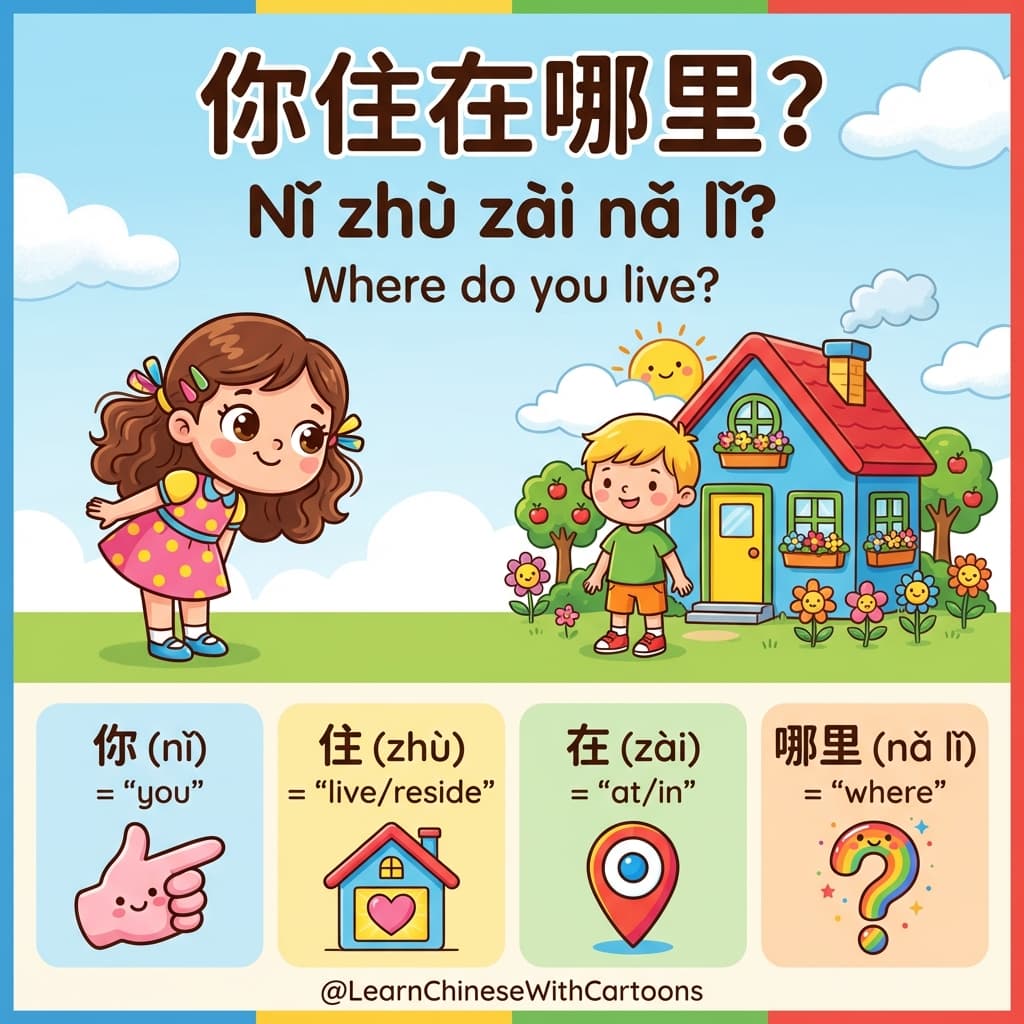
The Key Phrase: 你住在哪里? (Nǐ zhù zài nǎ lǐ?)
This phrase is your golden ticket to understanding people’s lives in China. Whether you’re meeting a new friend, talking to a neighbor, or just trying to find your way home, knowing how to ask and answer 'Where do you live?' is essential.
Word-by-Word Breakdown:
1. 你 (Nǐ) - You [3rd tone]
2. 住 (zhù) - To live / To stay [4th tone]
3. 在 (zài) - At / In (preposition) [4th tone]
4. 哪里 (nǎ lǐ) - Where [3rd + 3rd tone] (Note: When two 3rd tones are together, the first one changes to a 2nd tone: ná lǐ).
Leo adjusted his glasses, feeling a bit embarrassed that he had accidentally asked Mrs. Wang where she lived instead of asking where his friend lived.
'Oh! Sorry, Ayi,' Leo corrected himself. 'I am looking for my friend, Wei. He just moved here. I wanted to ask him, **你住在哪里?(Nǐ zhù zài nǎ lǐ?) [Where do you live?]** but his phone is dead.'
Mrs. Wang nodded knowingly. 'Ah, the young people and their dead phones. Every building here looks the same to a newcomer. But look at the door plates.' She pointed to a small red sign above a wooden door. 'This is Lane 12. You need Lane 14.'
As they walked together, a delivery driver on a blue scooter zoomed past, screeching to a halt at a fork in the road. He looked at a package, then at the confusing numbers on the wall. He turned to Leo and Mrs. Wang, shouting over the hum of his engine, 'Excuse me! **你住在哪里?(Nǐ zhù zài nǎ lǐ?) [Where do you live?]** Do you know where Building 2 is?'
Mrs. Wang waved him toward the left. 'Keep going, past the old well!'
She turned back to Leo. 'You see? Even the pros get lost here. So, tell me, **你住在哪里?(Nǐ zhù zài nǎ lǐ?) [Where do you live?]** You don't look like you're from this district.'
'I live in Xuhui,' Leo replied, proud he could use the structure. '我住在徐汇 (Wǒ zhù zài Xúhuì).'
'Xuhui! Very fancy,' Mrs. Wang teased. They finally reached a heavy iron gate labeled 'Lane 14.' Just as Leo was about to thank her, his phone vibrated. It was a text from Wei: 'Leo! I’m standing by the fruit stand at the entrance. **你住在哪里?(Nǐ zhù zài nǎ lǐ?) [Where do you live?]** I mean—where are you right now? I don't see you!'
Leo laughed and typed back: 'I'm with a local expert! I'll be there in two minutes.'
As he walked toward the fruit stand, he saw a security guard sitting on a small stool. The guard looked up from his newspaper. 'Hey! You're the one looking for Building 2? **你住在哪里?(Nǐ zhù zài nǎ lǐ?) [Where do you live?]** You need to sign the guest book first.'
Finally, after signing the book and waving goodbye to Mrs. Wang, Leo spotted Wei by the crates of watermelons.
'There you are!' Wei shouted. 'Man, this place is a labyrinth.'
'It's okay,' Leo said, pointing back toward the winding lanes. 'I think I finally figured out the answer to **你住在哪里?(Nǐ zhù zài nǎ lǐ?)**'
In English, we say 'I live in...' or 'I live at...' In Chinese, the verb 住 (zhù) is almost always followed by the preposition 在 (zài).
Structure: Subject + 住 + 在 + Place
Example:
- 我住在北京。(Wǒ zhù zài Běijīng.) [I live in Beijing.]
- 他住在大华公寓。(Tā zhù zài Dàhuá gōngyù.) [He lives in Dahua Apartment.]
Asking the question:
To turn this into a question, we simply replace the 'Place' with the question word 哪里 (nǎ lǐ).
- 你住在哪里? (Nǐ zhù zài nǎ lǐ?)
Note on '哪里' vs '哪儿':
In Southern China (like Shanghai or Taiwan), people prefer 'nǎ lǐ'. In Northern China (like Beijing), you will often hear 'nǎ’er' (哪儿). Both are perfectly correct!
When someone asks you '你住在哪里?' in China, they aren't just asking for your city. They are often asking for your 'Xiǎoqū' (小区) or residential compound. Unlike many Western cities where houses face public streets, most urban Chinese housing is organized into gated communities with their own security, parks, and sometimes even shops.
Understanding the hierarchy of a Chinese address is key:
1. Province (省 - shěng)
2. City (市 - shì)
3. District (区 - qū)
4. Street/Road (路 - lù)
5. Compound (小区 - xiǎoqū)
6. Building Number (楼/栋 - lóu/dòng)
7. Unit/Apartment Number (室 - shì)
1. 城市 (chéngshì) - City
2. 公寓 (gōngyù) - Apartment
3. 地址 (dìzhǐ) - Address
4. 附近 (fùjìn) - Nearby
5. 路 (lù) - Road / Street
6. 号 (hào) - Number (in an address)
7. 楼 (lóu) - Building / Floor
8. 邻居 (línjū) - Neighbor
9. 搬家 (bānjiā) - To move house
10. 故乡 (gùxiāng) - Hometown
Leo: 你好!请问,14弄在哪里?(Nǐ hǎo! Qǐngwèn, shísì nòng zài nǎlǐ?) [Hello! Excuse me, where is Lane 14?]
Mrs. Wang: 就在前面。你是新搬来的吗?(Jiù zài qiánmiàn. Nǐ shì xīn bānlái de ma?) [It's right ahead. Are you a new mover?]
Leo: 不是,我来找朋友。 (Búshì, wǒ lái zhǎo péngyǒu.) [No, I'm here to find a friend.]
Mrs. Wang: 你住在哪里?(Nǐ zhù zài nǎ lǐ?) [Where do you live?]
Leo: 我住在徐汇区,离这里不远。(Wǒ zhù zài Xúhuì qū, lí zhèlǐ bù yuǎn.) [I live in Xuhui District, not far from here.]
Mrs. Wang: 那你的朋友住在哪里?(Nà nǐ de péngyǒu zhù zài nǎ lǐ?) [Then where does your friend live?]
Leo: 他住在14弄5号201室。(Tā zhù zài shísì nòng wǔ hào èrlíngyī shì.) [He lives in Lane 14, No. 5, Room 201.]
Mrs. Wang: 我知道了,那是老张的旧房子。跟我来吧。(Wǒ zhīdàole, nà shì Lǎo Zhāng de jiù fángzi. Gēn wǒ lái ba.) [I know it, that’s Old Zhang’s old house. Follow me.]
Today we learned the essential phrase **你住在哪里?(Nǐ zhù zài nǎ lǐ?)**. We explored how '住' (to live) pairs with '在' (at) to describe locations, and we peeked into the unique layout of Chinese residential life. Remember, practice makes perfect! Try asking your classmates or language partners about their 'Xiǎoqū' this week.
1. How do you say 'I live in Shanghai' in Chinese?
2. What does '哪里' (nǎ lǐ) mean?
3. In the phrase '你住在哪里?', which word is the preposition?
4. True or False: '哪儿' and '哪里' have the same meaning.
5. What is the Chinese word for 'Apartment'?