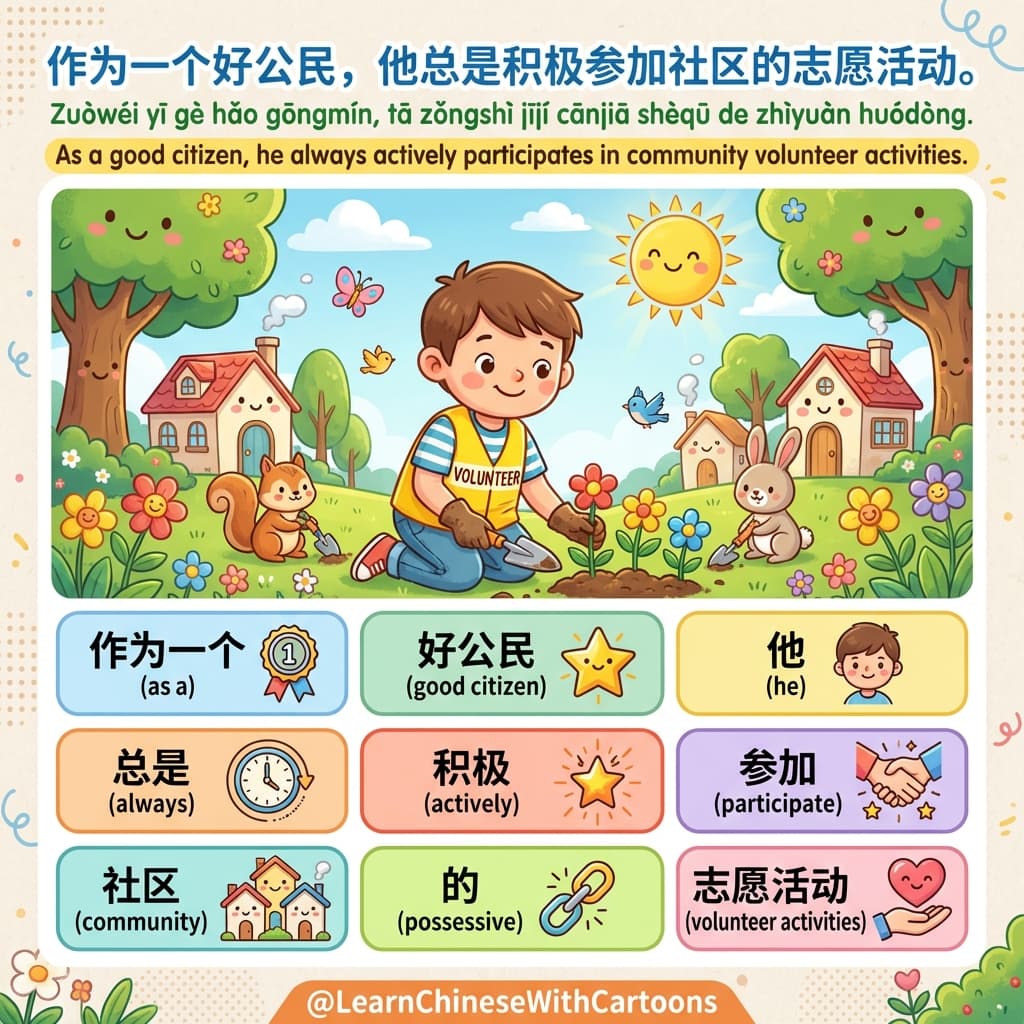
The morning sun crawled over the grey-tiled roofs of Willow Lane, a quiet hutong tucked away in the heart of Beijing. Leo, an expat who had called this alley home for three years, adjusted his red volunteer armband. To his neighbors, he wasn't just 'the foreigner' anymore; he was a fixture of the community. In every neighborhood meeting, the local committee leader would point him out with pride. Why? Because 作为一个好公民,他总是积极参加社区的志愿活动 (Zuòwéi yī gè hǎo gōngmín, tā zǒngshì jījí cānjiā shèqū de zhìyuàn huódòng.)—'As a good citizen, he always actively participates in community volunteer activities.'
The Phrase of the Day
Before we dive deeper into the mystery of Willow Lane, let's break down our key sentence piece by piece: 1. 作为 (zuòwéi) – As / In the capacity of; 2. 一个 (yī gè) – A / One; 3. 好 (hǎo) – Good; 4. 公民 (gōngmín) – Citizen; 5. 他 (tā) – He; 6. 总是 (zǒngshì) – Always; 7. 积极 (jījí) – Actively / Positively; 8. 参加 (cānjiā) – To participate / To join; 9. 社区 (shèqū) – Community; 10. 的 (de) – (Possessive particle); 11. 志愿活动 (zhìyuàn huódòng) – Volunteer activities.
The Story: The Key in the Drain
Leo’s dedication wasn't just for show. He genuinely loved the rhythm of the hutong. However, his reputation was his strongest shield. Whenever the police or city officials came snooping around about missing documents or local gossip, the elderly residents would defend him. They would tell the officers, 'Leo is one of us. 作为一个好公民,他总是积极参加社区的志愿活动 (Zuòwéi yī gè hǎo gōngmín, tā zǒngshì jījí cānjiā shèqū de zhìyuàn huódòng).' This phrase had become his passport to the neighborhood's trust.
One humid Tuesday, Leo was helping clear out a clogged drainage pipe near the old temple. It was dirty, back-breaking work, but he didn't mind. His neighbor, Old Mr. Wang, watched him from a stool while sipping tea. 'Leo,' Wang shouted, 'you're more dedicated than the young kids born here! 作为一个好公民,你总是积极参加社区的志愿活动 (Zuòwéi yī gè hǎo gōngmín, nǐ zǒngshì jījí cānjiā shèqū de zhìyuàn huódòng).' Leo smiled, wiped the sweat from his brow, and reached deep into the muck. His fingers brushed against something cold and metallic. It was a heavy, ornate brass key wrapped in oilcloth.
He tucked the object into his pocket. He knew better than to reveal a discovery in the middle of the street. That evening, as he wrote his weekly report for the neighborhood committee, he felt a twinge of guilt. The report was supposed to document everything he did. After all, the committee's records stated that 作为一个好公民,他总是积极参加社区的志愿活动 (Zuòwéi yī gè hǎo gōngmín, tā zǒngshì jījí cānjiā shèqū de zhìyuàn huódòng), and 'good citizens' don't hide ancient keys. But Leo felt this key held a secret about Willow Lane that even the committee didn't know.
Grammar Deep Dive
The Structure of 'Zuowei' (作为): '作为' is a versatile word used to define a role or capacity. It often appears at the beginning of a sentence to set the context for the subject's actions. Example: 作为老师,他很有耐心 (Zuòwéi lǎoshī, tā hěn yǒu nàixīn) – As a teacher, he is very patient.
Cultural Corner: The Power of the 'Shequ'
In China, the 'Shequ' (社区 - community) is more than just a place to live. It is a social and administrative unit. Neighborhood committees often organize 'volunteer activities' (志愿活动) like patrolling the streets, helping the elderly, or cleaning public spaces. These activities are seen as essential for social harmony.
Lesson Summary & Quiz
1. What does '社区' mean? a) School b) Community c) Hospital. 2. Translate: '志愿活动' a) Office work b) Sports game c) Volunteer activities. 3. Fill in the blank: 作为一个___公民,他总是帮助别人。 a) 坏 (huài) b) 好 (hǎo) c) 大 (dà). 4. How do you say 'to participate' in Mandarin? a) 参加 (cānjiā) b) 学习 (xuéxí) c) 睡觉 (shuìjiào).