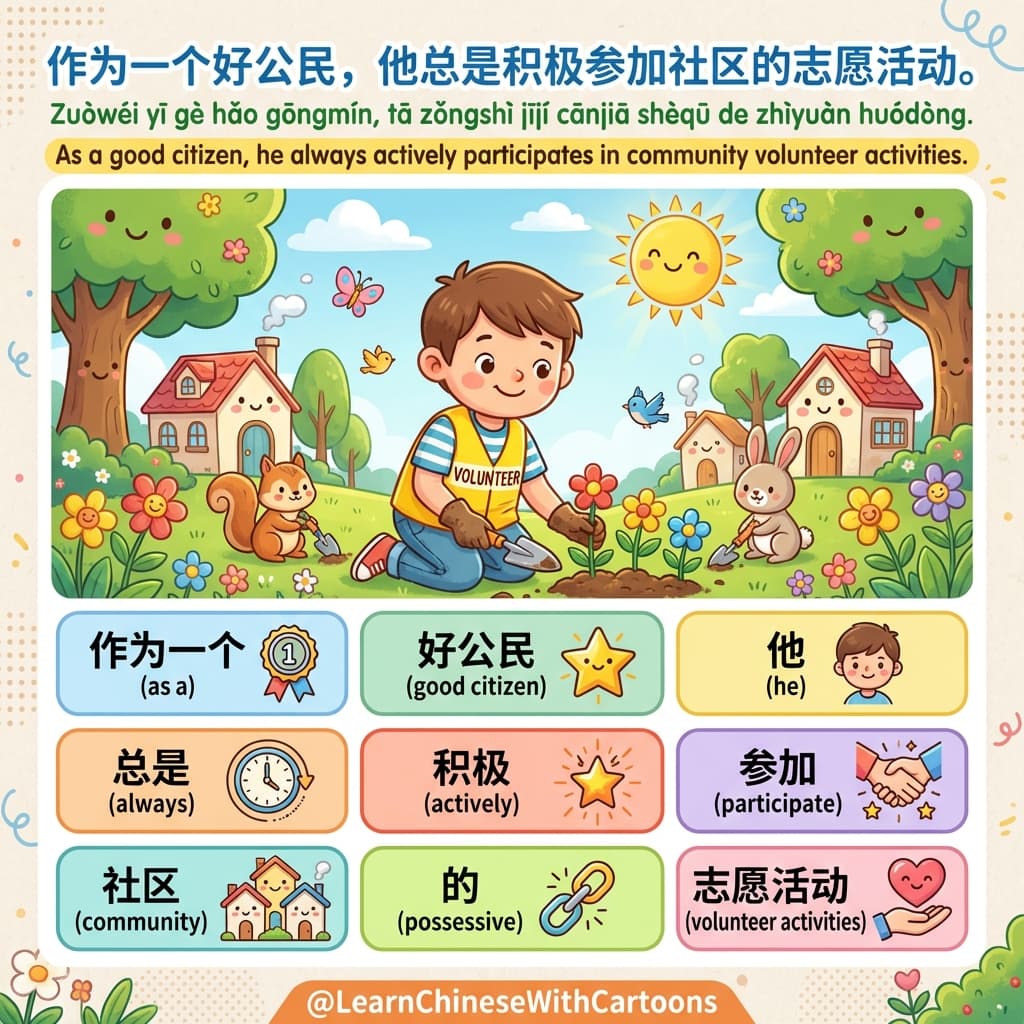
The rain in Neo-Lóng didn't just fall; it glowed. It was a digital drizzle, shimmering with the neon reflections of a thousand holographic advertisements. Kael, an expat from a world that felt much flatter and quieter, adjusted his coat and watched the street from his small balcony. Below, the city was a labyrinth of light and shadow, but there was one figure who always seemed to stand out in the rhythmic chaos. It was Old Chen. While everyone else hurried through the rain, eyes glued to their wrist-displays, Old Chen was often seen kneeling by a broken street-sensor or helping an elderly neighbor navigate the slick sidewalks. Kael’s landlord, Mrs. Wang, often spoke of him with a mixture of reverence and mystery. One evening, as she handed Kael his mail, she pointed out the window at Old Chen. 'You should learn from him,' she said. '作为一个好公民,他总是积极参加社区的志愿活动。(Zuòwéi yī gè hǎo gōngmín, tā zǒngshì jījí cānjiā shèqū de zhìyuàn huódòng.)' [As a good citizen, he always actively participates in community volunteer activities.] Kael nodded, though he wondered if there was more to Old Chen’s 'volunteer work' than met the eye.
The Key Phrase: 作为一个好公民,他总是积极参加社区的志愿活动。
(Zuòwéi yī gè hǎo gōngmín, tā zǒngshì jījí cānjiā shèqū de zhìyuàn huódòng.)
Meaning: As a good citizen, he always actively participates in community volunteer activities.
Word-by-Word Breakdown:
1. 作为 (zuòwéi) - As / in the capacity of
2. 一个 (yī gè) - A / one
3. 好 (hǎo) - Good
4. 公民 (gōngmín) - Citizen
5. 他 (tā) - He
6. 总是 (zǒngshì) - Always
7. 积极 (jījí) - Actively / energetically
8. 参加 (cānjiā) - Participate in / join
9. 社区 (shèqū) - Community / neighborhood
10. 的 (de) - (Possessive particle)
11. 志愿 (zhìyuàn) - Volunteer
12. 活动 (huódòng) - Activity
The following week, the city’s central AI hub experienced a massive surge. The holograms flickered, and the streetlights hummed with a dangerous frequency. While most residents retreated indoors, fearing a system-wide crash, Kael saw Old Chen in the plaza. He was wearing a bright orange vest, directing people away from the sparking conduits. A young girl had dropped her digital tablet, and Old Chen calmly picked it up, wiped the rain off, and handed it back with a smile. A local news drone hovered nearby, its mechanical voice broadcasting to the district: 'Look at Mr. Chen. 作为一个好公民,他总是积极参加社区的志愿活动。(Zuòwéi yī gè hǎo gōngmín, tā zǒngshì jījí cānjiā shèqū de zhìyuàn huódòng.)' Kael watched from the shadows. Old Chen wasn't just directing traffic; he was plugging a small, silver device into the city's main terminal. Kael’s heart hammered. Was he a hacker? A savior? Or both? Later that night, Kael saw the phrase again, printed on a community poster near the subway: 'Learn from Old Chen. 作为一个好公民,他总是积极参加社区的志愿活动。(Zuòwéi yī gè hǎo gōngmín, tā zǒngshì jījí cānjiā shèqū de zhìyuàn huódòng.)' The repetition was starting to feel like a secret code.
Driven by curiosity, Kael decided to follow Old Chen the next Saturday. They wound through the narrow alleys of the Old District, where the neon was dimmer and the shadows longer. Old Chen stopped at a community center that looked more like a high-tech laboratory. Inside, several other residents were busy repairing discarded drones and re-coding old medical bots for the local clinic. Kael accidentally tripped over a loose cable, alerting the group. Old Chen looked up, not with anger, but with a welcoming smile. 'Welcome, Kael,' he said. 'I was wondering when you'd join us. Mrs. Wang told you, didn't she? 作为一个好公民,他总是积极参加社区的志愿活动。(Zuòwéi yī gè hǎo gōngmín, tā zǒngshì jījí cānjiā shèqū de zhìyuàn huódòng.) Well, in this neighborhood, "volunteer activities" mean keeping our city from falling apart from the inside.' Kael realized then that Old Chen and his team were the silent engineers of Neo-Lóng, fixing what the government ignored. 'We need more people like you,' Chen continued. 'People who understand that 作为一个好公民,他总是积极参加社区的志愿活动。(Zuòwéi yī gè hǎo gōngmín, tā zǒngshì jījí cānjiā shèqū de zhìyuàn huódòng.) is more than a slogan; it's a survival strategy.' Even the local robotic pet shop owner, who was there fixing a robotic cat, agreed, saying, 'Indeed, 作为一个好公民,他总是积极参加社区的志愿活动。(Zuòwéi yī gè hǎo gōngmín, tā zǒngshì jījí cānjiā shèqū de zhìyuàn huódòng.) is the only reason this district still has clean air.'
Grammar Deep Dive: The Power of 'Zuòwéi' (作为)
In our key phrase, '作为' (zuòwéi) is used to establish a role or identity. It means 'as' or 'in the capacity of.' This is a very common way to introduce a person's responsibility or the perspective from which they are acting.
Structure: 作为 + Role, Subject + Action.
Example: 作为学生,我们要努力学习。(Zuòwéi xuéshēng, wǒmen yào nǔlì xuéxí.) [As students, we must study hard.]
Another key part of the phrase is the adverb '积极' (jījí). While it can mean 'positive,' when placed before an action (like 参加 - participate), it means 'actively' or 'energetically.' It describes the *manner* in which the action is performed.
Structure: Subject + 总是 (always) + 积极 (actively) + Verb.
Cultural Corner: Community and Volunteerism in China
In modern Chinese cities, the concept of '社区' (shèqū - community) is very strong. Often, you will see 'Shequ' offices that organize everything from recycling drives to dance classes for the elderly. Volunteering (志愿活动) is highly encouraged and often tied to a sense of social responsibility. Interestingly, the 'Dà mā' (neighborhood aunties) are often the unofficial leaders of these volunteer efforts, keeping an eye on the safety and cleanliness of their streets. In Neo-Lóng, our fictional city, this takes a sci-fi turn, but the core value remains: the health of the community depends on the active participation of its citizens.
Related Vocabulary:
1. 公民 (gōngmín) - Citizen
2. 积极 (jījí) - Actively / Positive
3. 参加 (cānjiā) - To participate
4. 志愿 (zhìyuàn) - Volunteer
5. 活动 (huódòng) - Activity
6. 社区 (shèqū) - Community
7. 贡献 (gòngxiàn) - Contribution
8. 责任 (zérèn) - Responsibility
9. 邻居 (línjū) - Neighbor
10. 帮助 (bāngzhù) - To help
11. 环境 (huánjìng) - Environment
12. 改善 (gǎishàn) - To improve
Dialogue Practice: A Conversation with Mrs. Wang
Kael: 王奶奶,陈先生去哪儿了?(Wáng nǎinai, Chén xiānshēng qù nǎr le?) [Mrs. Wang, where did Mr. Chen go?]
Mrs. Wang: 他去公园打扫卫生了。(Tā qù gōngyuán dǎsǎo wèishēng le.) [He went to the park to clean up.]
Kael: 他每天都这么忙吗?(Tā měitiān dōu zhème máng ma?) [Is he this busy every day?]
Mrs. Wang: 是啊,作为一个好公民,他总是积极参加社区的志愿活动。(Shì a, zuòwéi yī gè hǎo gōngmín, tā zǒngshì jījí cānjiā shèqū de zhìyuàn huódòng.) [Yes, as a good citizen, he always actively participates in community volunteer activities.]
Kael: 我也想参加。我该怎么做?(Wǒ yě xiǎng cānjiā. Wǒ gāi zěnme zuò?) [I want to participate too. What should I do?]
Mrs. Wang: 太好了!你可以先从回收垃圾开始。(Tài hǎole! Nǐ kěyǐ xiān cóng huíshōu lājī kāishǐ.) [Great! You can start with recycling trash.]
Kael: 没问题,我也想为社区做点贡献。(Méi wèntí, wǒ yě xiǎng wèi shèqū zuò diǎn gòngxiàn.) [No problem, I also want to make a contribution to the community.]
Mrs. Wang: 社区需要你这样的小伙子。(Shèqū xūyào nǐ zhèyàng de xiǎohuǒzi.) [The community needs young men like you.]
Kael picked up a wrench and joined the table. He spent the afternoon learning how to recalibrate the neighborhood's air filtration sensors. It wasn't just about 'being good'; it was about belonging. As the sun set, casting a deep violet hue over the metallic towers of Neo-Lóng, Kael realized that his journey as an expat had truly begun. He was no longer just a resident; he was a participant. And as Old Chen handed him a cup of hot tea, Kael finally understood the weight and the warmth behind the words: 作为一个好公民,他总是积极参加社区的志愿活动。(Zuòwéi yī gè hǎo gōngmín, tā zǒngshì jījí cānjiā shèqū de zhìyuàn huódòng.) Every light that flickered to life that night was a testament to that silent, persistent effort.
Lesson Summary & Quiz:
1. What does '作为' (zuòwéi) mean in this lesson?
A) Because
B) As / In the capacity of
C) Doing
2. Which word means 'actively'?
A) 总是 (zǒngshì)
B) 参加 (cānjiā)
C) 积极 (jījí)
3. True or False: '社区' (shèqū) refers to a school campus.
4. Translate to Chinese: 'Good citizen'.
A) 好社区 (hǎo shèqū)
B) 好公民 (hǎo gōngmín)
C) 好志愿 (hǎo zhìyuàn)
5. In the phrase, what is the purpose of '的' (de)?
A) To indicate past tense
B) To link 'community' and 'volunteer activities'
C) To ask a question