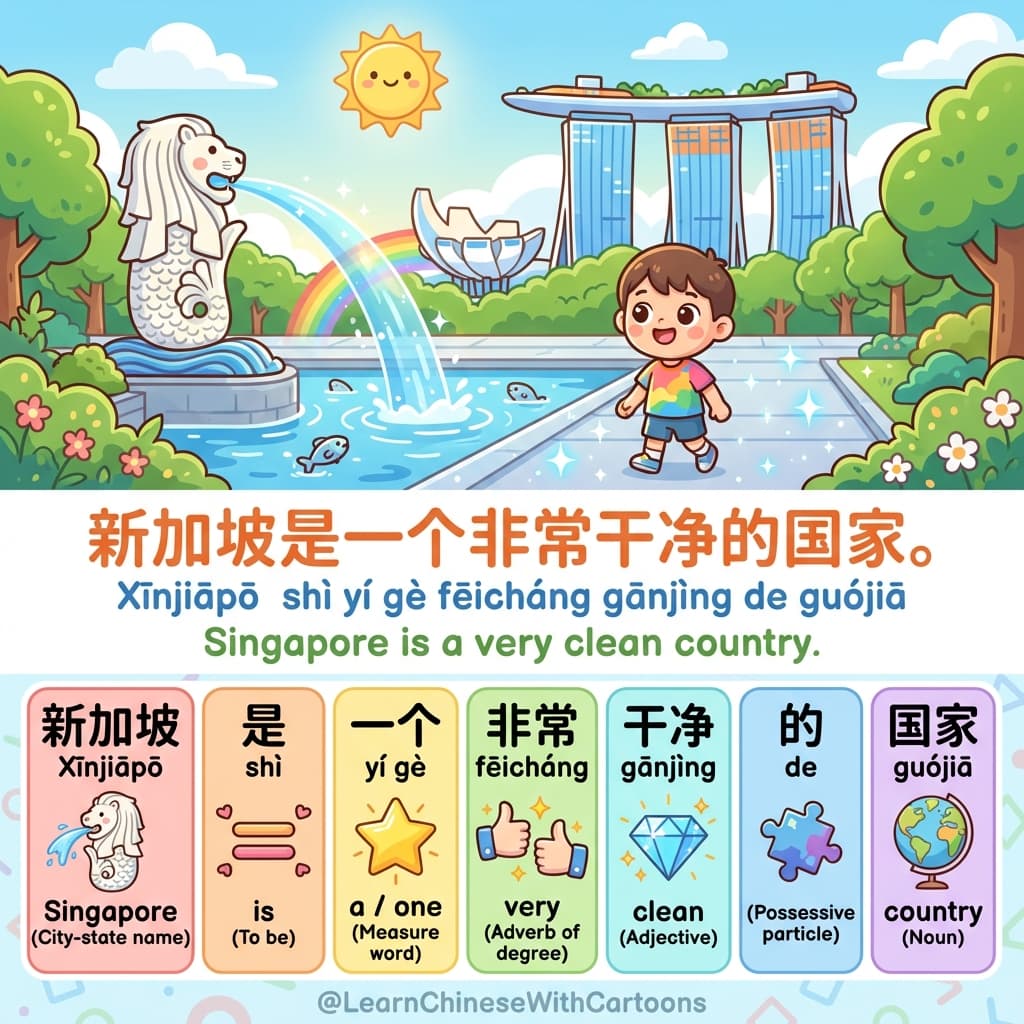
Leo stood on the balcony of his hotel room, his camera lens cap still on. For a man who had spent the last decade photographing the 'underbelly' of global megacities—the grimy alleyways of Berlin, the steam-filled vents of New York, and the chaotic neon sprawl of Tokyo—Singapore was a shock to his system. He looked down at the street below. There wasn't a single discarded cigarette butt. Not a gum wrapper. Not even a stray leaf that didn't look like it had fallen with artistic intent.
His guide for the week, a local artist named Wei, had greeted him at the airport with a proud smile. When Leo asked where he could find some 'authentic urban grit' to photograph, Wei had simply laughed and said, "Leo, you might have a hard time here. 新加坡是一个非常干净的国家。" (Xīnjiāpō shì yí gè fēicháng gānjìng de guójiā.) [Singapore is a very clean country.]
The Key Phrase: 新加坡是一个非常干净的国家 (Xīnjiāpō shì yí gè fēicháng gānjìng de guójiā)
Let's break down this essential sentence before we dive deeper into Leo's quest for imperfection:
1. 新加坡 (Xīnjiāpō) - Singapore (Proper Noun)
2. 是 (shì) - Is / To be (Verb)
3. 一个 (yí gè) - A / One (Measure word phrase)
4. 非常 (fēicháng) - Very / Extremely (Adverb)
5. 干净 (gānjìng) - Clean / Spotless (Adjective)
6. 的 (de) - Adjective marker (Particle)
7. 国家 (guójiā) - Country / Nation (Noun)
Leo’s first day was a failure—at least by his usual standards. He spent four hours walking through the historic district of Chinatown. He expected to find peeling paint or rusted pipes. Instead, he found vibrant, freshly painted shutters and floors so polished they reflected the tropical sun. He sat down at a hawker center and watched a cleaning robot glide silently past. He sighed, thinking to himself, "It’s true. 新加坡是一个非常干净的国家。" (Xīnjiāpō shì yí gè fēicháng gānjìng de guójiā.)
By the third day, Leo started to change his perspective. He met Wei at the Gardens by the Bay. The massive Supertrees towered above them, glowing with bio-luminescent light. There was no litter in the water features, no graffiti on the concrete. "I wanted to find a story about struggle," Leo admitted, "but all I find is harmony." Wei nodded. "In other places, cleanliness is a chore. Here, it’s our culture. 新加坡是一个非常干净的国家。" (Xīnjiāpō shì yí gè fēicháng gānjìng de guójiā.)
Leo began to photograph the reflections instead of the grime. He captured the way the city looked after a sudden afternoon downpour. The rainwater didn't turn into sludge; it washed the streets until they gleamed like diamonds. He realized that the beauty wasn't in the mess, but in the care taken to prevent it. He messaged his editor: 'The exhibition is changing. The theme is "Purity." Because, as I've learned, 新加坡是一个非常干净的国家。' (Xīnjiāpō shì yí gè fēicháng gānjìng de guójiā.)
On his final night, Leo sat at a rooftop bar overlooking the Marina Bay Sands. The skyline was a masterpiece of glass and light. He looked at his portfolio—hundreds of shots of a city that looked like a futuristic dream. He finally understood why the locals were so proud. When a tourist at the next table complained that they couldn't find a place to spit their sunflower seeds, Leo turned and said in his newly practiced Mandarin: "You shouldn't do that here. 新加坡是一个非常干净的国家。" (Xīnjiāpō shì yí gè fēicháng gānjìng de guójiā.)
As he boarded his flight home, he looked at the polished floors of Changi Airport one last time. He realized he didn't miss the grit. He had found something better: a vision of what a city could be if everyone cared. He whispered to himself, "新加坡是一个非常干净的国家。" (Xīnjiāpō shì yí gè fēicháng gānjìng de guójiā.) and closed his eyes, already planning his return.
In our main phrase, we use '非常' (fēicháng) to mean 'very' or 'extremely.' While '很' (hěn) is the most common way to say 'very,' '非常' adds an extra level of intensity.
- Example: 很好 (hěn hǎo) = Very good.
- Example: 非常好 (fēicháng hǎo) = Extremely good / Fantastic.
When describing Singapore's cleanliness, '非常' is appropriate because it highlights an exceptional quality of the nation.
Cultural Corner: The 'Fine' City
Related Vocabulary:
1. 城市 (chéngshì) - City
2. 环境 (huánjìng) - Environment
3. 垃圾 (lājī) - Trash / Garbage
4. 法律 (fǎlǜ) - Law
5. 罚款 (fákuǎn) - Fine / Penalty
6. 整洁 (zhěngjié) - Tidy / Neat
7. 绿化 (lǜhuà) - Greenery / Afforestation
8. 保护 (bǎohù) - To protect
9. 养成 (yǎngchéng) - To develop (a habit)
10. 习惯 (xíguàn) - Habit
Leo: 请问,最近的地铁站在哪里? (Qǐngwèn, zuìjìn de dìtiě zhàn zài nǎlǐ?) [Excuse me, where is the nearest MRT station?]
Staff: 就在那边,过马路就到了。 (Jiù zài nàbiān, guò mǎlù jiù dào le.) [Right over there, just cross the road and you're there.]
Leo: 谢谢。我发现这里的街道真的很整洁。 (Xièxiè. Wǒ fāxiàn zhèlǐ de jiēdào zhēn de hěn zhěngjié.) [Thanks. I've noticed the streets here are really tidy.]
Staff: 是的,新加坡是一个非常干净的国家。 (Shìde, Xīnjiāpō shì yí gè fēicháng gānjìng de guójiā.) [Yes, Singapore is a very clean country.]
Leo: 连地铁里也没有一点垃圾。 (Lián dìtiě lǐ yě méiyǒu yìdiǎn lājī.) [Even in the MRT, there isn't a bit of trash.]
Staff: 我们有严格的法律,不能在车厢内饮食。 (Wǒmen yǒu yángé de fǎlǜ, bùnéng zài chēxiāng nèi yǐnshí.) [We have strict laws; you cannot eat or drink in the carriages.]
Leo: 难怪环境维护得这么好。 (Nánguài huánjìng wéihù de zhème hǎo.) [No wonder the environment is maintained so well.]
Staff: 大家都很有意识,这让我们的城市更美。 (Dàjiā dōu hěn yǒu yìshí, zhè ràng wǒmen de chéngshì gèng měi.) [Everyone is very conscious, which makes our city more beautiful.]
Today we learned how to describe Singapore's unique environment using the phrase '新加坡是一个非常干净的国家。' We also explored the grammar of intensity with '非常' and looked at the cultural reasons behind this reputation.
Quiz:
1. What does '干净' (gānjìng) mean?
2. How do you say 'Country' in Mandarin?
3. What is the difference between '很' and '非常'?
4. True or False: '垃圾' means greenery. (False: It means trash!)