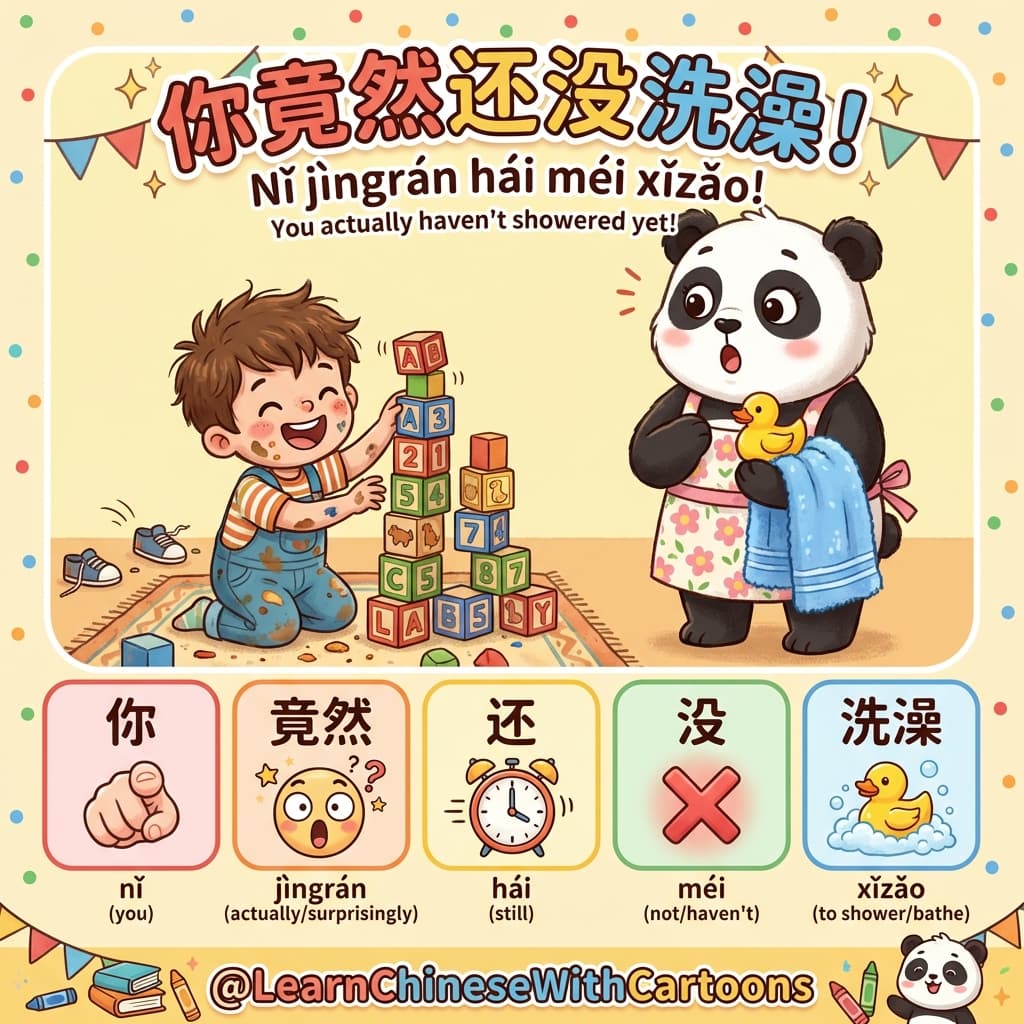
The neon lights of Neo-Shanghai flickered through the rain-streaked window of Apartment 404. Leo slumped against the door, his breath coming in ragged gasps. His trench coat was soaked, not just with rainwater, but with a strange, glowing green slime from the underground bio-labs. He had the microchip, but he also had a stench that could peel paint off a wall. Just as he kicked off his boots, the lights hummed to life. Standing there, arms crossed and face twisted in a mask of pure disbelief, was his partner, Meiling. She didn’t ask about the mission. She didn’t ask about the chip. She pointed a trembling finger at him and shrieked.
“你竟然还没洗澡!” (Nǐ jìngrán hái méi xǐzǎo!)
The phrase hung in the air, heavier than the humidity of the city outside. To an outsider, it was a nagging complaint. To Leo, it was the sound of his cover being blown by his own hygiene.
Key Phrase Breakdown:
Before we dive deeper into Leo's precarious situation, let's look at the mechanics of this powerful sentence:
1. 你 (nǐ) — You.
2. 竟然 (jìngrán) — Unexpectedly; to one's surprise; actually. This is the star of the show, used when something is shocking or contrary to expectation.
3. 还 (hái) — Still; yet.
4. 没 (méi) — Not (used to negate past actions or completions).
5. 洗澡 (xǐzǎo) — To take a shower or bath.
The Story Continues...
Grammar Deep Dive: Using 竟然 (jìngrán) and 还 (hái)
The word 竟然 (jìngrán) is an adverb that adds a layer of 'disbelief' or 'unexpectedness' to a sentence. It’s stronger than 'actually' and often implies that the speaker thinks the situation is somewhat ridiculous or surprising.
Structure: Subject + 竟然 + Verb/Adjective.
Example:
他竟然忘了我的生日。(Tā jìngrán wàngle wǒ de shēngrì.) — He actually forgot my birthday! (I can't believe it!)
Combined with 还 (hái), which means 'still' or 'yet,' the phrase "你竟然还没..." (Nǐ jìngrán hái méi...) creates a sense of urgent disbelief. You are not just saying someone hasn't done something; you are saying it is shocking that they haven't done it by now.
Note on 没 (méi) vs 不 (bù):
We use 没 (méi) here because "showering" is a completed action in this context (or a lack thereof). You wouldn't say "你不洗澡" in this specific case unless you were saying "You don't shower" as a general habit.
Cultural Corner: Hygiene and Social Etiquette in China
In modern Chinese urban culture, showering (洗澡 - xǐzǎo) is typically done at night before bed. This is rooted in the idea of washing away the 'dust' of the outside world before entering the clean sanctuary of the home.
In Northern China, there is also a rich tradition of public bathhouses (澡堂 - zǎotáng). While less common in the ultra-modern sci-fi Shanghai we imagined, in real life, these are places for social bonding, where people go not just to clean themselves, but to relax in hot pools and receive professional "scrubs" (搓澡 - cuōzǎo). To someone from a culture where showering is a private, quick morning task, the communal and thorough nature of a Chinese bathhouse is a fascinating cultural experience!
Related Vocabulary
1. 肥皂 (féizào) — Soap
2. 毛巾 (máojīn) — Towel
3. 味道 (wèidào) — Smell / Odor
4. 干净 (gānjìng) — Clean
5. 脏 (zāng) — Dirty
6. 马上 (mǎshàng) — Immediately
7. 秘密 (mìmì) — Secret
8. 任务 (rènwù) — Mission
9. 甚至 (shènzhì) — Even
10. 恐怕 (kǒngpà) — I’m afraid that... / Perhaps
Dialogue Practice: The Morning After the Mission
Lesson Summary & Quiz