The rain in Chengdu didn't fall like water; it fell like a heavy, grey curtain, separating the neon-lit modern malls from the ancient, narrow alleys of the Jinli district. Lin pulled her coat tighter, her leather shoes clicking against the slick cobblestones. She was twenty-eight, an overworked software developer whose only 'traveling' lately consisted of scrolling through Instagram photos of the Swiss Alps during her ten-minute lunch breaks. She was lost, both geographically and spiritually, until she saw it: a sign swaying in the wind, depicting a compass with a human eye in the center. The shop was called 'The Whispering Map.'
Inside, the air smelled of dried jasmine and old parchment. The walls were lined with thousands of drawers, and in the center of the room sat a massive, wooden table covered in a silk cloth. An old man with glasses as thick as bottle caps looked up. He didn't ask her name. He didn't ask what she was looking for. Instead, he leaned forward, his voice a gravelly whisper that seemed to echo from the walls themselves.
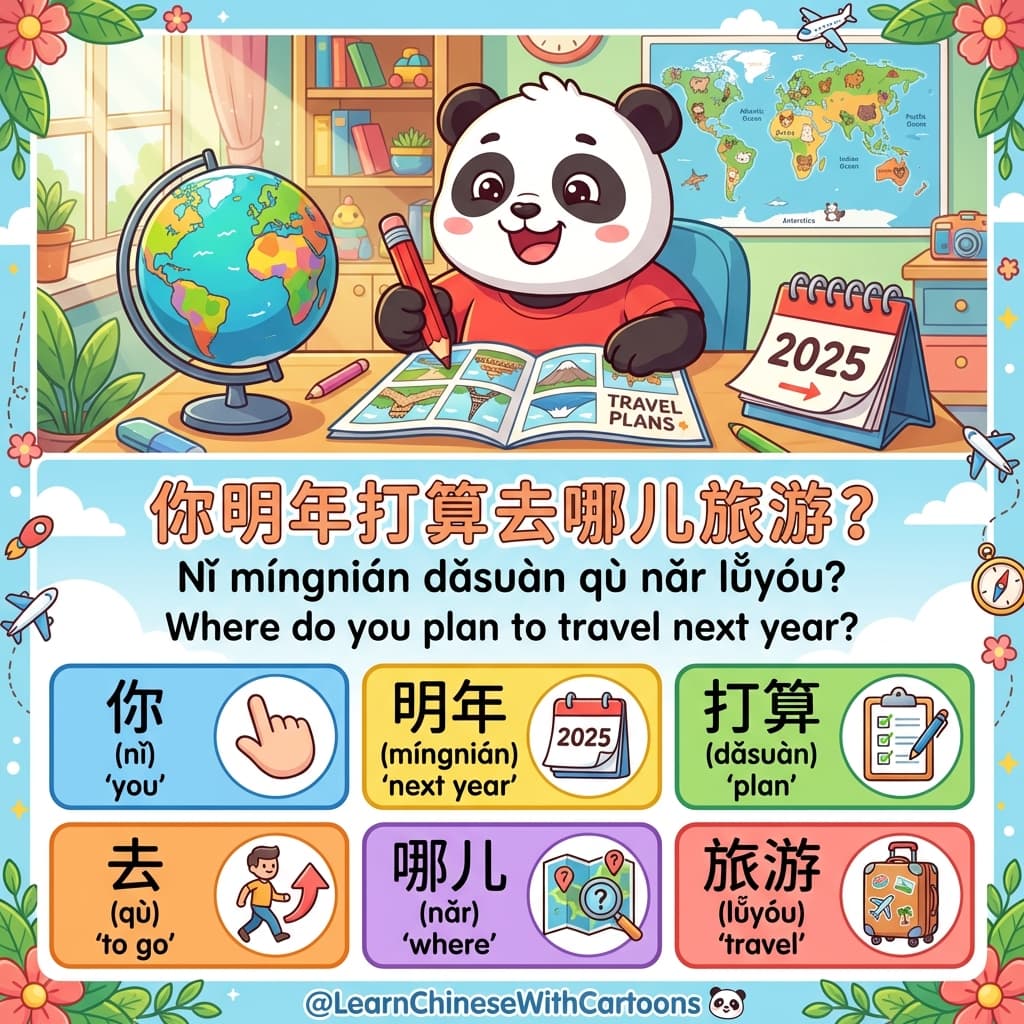
'你明年打算去哪儿旅游?(Nǐ míngnián dǎsuàn qù nǎr lǚyóu?)'
Lin froze. It was a simple question, yet in this room, it felt like a command. 'Where do you plan to travel next year?' The words hung in the air like smoke. She didn't have an answer. She hadn't even planned what she was having for dinner, let alone a trip a year away.
Key Phrase Introduction
The phrase we are focusing on today is: 你明年打算去哪儿旅游?(Nǐ míngnián dǎsuàn qù nǎr lǚyóu?) This is the most common way to ask someone about their future travel plans. It is polite, direct, and essential for making conversation with Chinese friends.
Word-by-Word Breakdown:
1. 你 (nǐ) – You (Tone: 3rd)
2. 明年 (míngnián) – Next year (Tone: 2nd, 2nd)
3. 打算 (dǎsuàn) – To plan / Intend (Tone: 3rd, 4th)
4. 去 (qù) – To go (Tone: 4th)
5. 哪儿 (nǎr) – Where (Tone: 3rd - Northern 'er' sound)
6. 旅游 (lǚyóu) – To travel / Tourism (Tone: 3rd, 2nd)
The story continues...
Lin looked at the old man, Master Zhou. 'I... I don't know,' she stammered. 'I work too much.' Zhou shook his head and pulled the silk cloth off the table. Beneath it was a map that seemed to pulse with a soft, golden light. 'The map only shows paths to those who can answer,' he said. 'Think carefully. '
'你明年打算去哪儿旅游?' (Nǐ míngnián dǎsuàn qù nǎr lǚyóu?)
Suddenly, a small, mechanical bird perched on a shelf began to chirp. To Lin's horror, it spoke in a high-pitched, metallic voice: 'Target acquired. '
Master Zhou tapped the map. The gold light shifted, forming the shape of a camel. 'The map is hungry for a destination, Lin. If you don't choose a path, the path will choose you. Usually, that path leads back to your office cubicle forever. So, tell me one more time: '
Lin grabbed the edge of the table. The room began to spin. She saw flashes of the Great Wall, the ice festivals of Harbin, and the tropical beaches of Sanya. A ghostly figure of a traveler from the Tang Dynasty appeared in the corner, holding a bamboo scroll. He pointed his staff at her and chanted the same question like a mantra: '
'Enough!' Lin shouted. 'I'm going to Dunhuang! I want to see the Mogao Caves! I want to see the Silk Road!' As soon as the words left her mouth, the golden light on the map solidified into a glowing line, stretching from Chengdu all the way to the northwest. Master Zhou smiled, his wrinkles deepening. 'A fine choice. The desert has been waiting for you.'
Grammar Deep Dive: Using '打算' (dǎsuàn) and '哪儿' (nǎr)
In Chinese, the word 打算 (dǎsuàn) is incredibly versatile. It can be used as a verb ('to plan') or a noun ('a plan'). In our phrase, it functions as a verb. Unlike English, where we often say 'Where are you planning to go,' Chinese structure usually follows: Subject + Time + 打算 + Verb + Place.
For example: 我 (Subject) 明年 (Time) 打算 (Plan) 去 (Go) 哪儿 (Where).
Another key point is the word 哪儿 (nǎr). This is the Northern Chinese variation of 哪里 (nǎlǐ). Both mean 'where,' but 'nǎr' is very common in Beijing and Northern provinces. If you prefer a more formal or Southern sound, you can say: 你明年打算去哪里旅游?(Nǐ míngnián dǎsuàn qù nǎlǐ lǚyóu?) Both are 100% correct!
Cultural Corner: Travel in Modern China
In China, travel is often dictated by 'Golden Weeks.' There are two major week-long holidays: Chinese New Year (Spring Festival) and National Day (October 1st). During these times, hundreds of millions of people travel simultaneously, a phenomenon known as 'Chunyun' for the New Year. Because of the massive crowds, many young Chinese professionals like Lin are now choosing to travel during 'off-peak' times or seeking out 'hidden gems' (小众景点 - xiǎozhòng jǐngdiǎn) to avoid the 'people mountain, people sea' (人山人海 - rén shān rén hǎi). Asking someone about their travel plans for the *next* year is a common way to talk about dreams and financial goals.
Related Vocabulary:
1. 护照 (hùzhào) – Passport
2. 签证 (qiānzhèng) – Visa
3. 机票 (jīpiào) – Plane ticket
4. 酒店 (jiǔdiàn) – Hotel
5. 风景 (fēngjǐng) – Scenery
6. 目的地 (mùdìdì) – Destination
7. 攻略 (gōnglüè) – Travel guide / Strategy
8. 拍照 (pāizhào) – To take photos
9. 订 (dìng) – To book/reserve
10. 行李箱 (xínglǐxiāng) – Suitcase
Dialogue Practice: Planning the Trip
Master Zhou: 你真的决定去敦煌了吗? (Nǐ zhēn de juédìng qù Dūnhuáng le ma?) [Have you really decided to go to Dunhuang?]
Lin: 是的,我一直想看莫高窟。 (Shì de, wǒ yīzhí xiǎng kàn Mògāokū.) [Yes, I've always wanted to see the Mogao Caves.]
Master Zhou: 那里很远,你打算怎么去? (Nàlǐ hěn yuǎn, nǐ dǎsuàn zěnme qù?) [It's very far, how do you plan to get there?]
Lin: 我打算先坐飞机到兰州,再坐火车。 (Wǒ dǎsuàn xiān zuò fēijī dào Lánzhōu, zài zuò huǒchē.) [I plan to fly to Lanzhou first, then take a train.]
Master Zhou: 你一个人去吗? (Nǐ yī gè rén qù ma?) [Are you going alone?]
Lin: 我想一个人去,我想去探险。 (Wǒ xiǎng yī gè rén qù, wǒ xiǎng qù tànxiǎn.) [I want to go alone; I want an adventure.]
Master Zhou: 好的。你需要办签证吗? (Hǎo de. Nǐ xūyào bàn qiānzhèng ma?) [Good. Do you need to apply for a visa?]
Lin: 不需要,我是中国人。 (Bù xūyào, wǒ shì Zhōngguórén.) [No, I am Chinese.]
Master Zhou: 祝你明年旅游愉快! (Zhù nǐ míngnián lǚyóu yúkuài!) [I wish you a happy trip next year!]
Lin: 谢谢你,周师傅! (Xièxiè nǐ, Zhōu shīfu!) [Thank you, Master Zhou!]
Story Conclusion
As Lin stepped out of 'The Whispering Map,' the rain had stopped. The moon was visible, hanging over the Chengdu skyline like a silver coin. She felt a strange weight in her pocket. Reaching in, she found a small piece of the golden map, torn perfectly to show the route to Dunhuang. She smiled. For the first time in years, she wasn't just working for the weekend. She was living for the journey. She pulled out her phone and messaged her boss: 'I'm taking two weeks off next September. Don't ask why.' She already knew the answer. She was going to see the world.
Lesson Summary & Quiz
Today we learned the essential phrase for discussing travel plans. Remember: 打算 (dǎsuàn) is your best friend when talking about the future!
Quiz:
1. How do you say 'Next Year' in Mandarin?
a) 去年 (qùnián)
b) 明年 (míngnián)
c) 今天 (jīntiān)
2. What does '旅游' (lǚyóu) mean?
a) To work
b) To sleep
c) To travel
3. Translate this sentence: 'I plan to go to Beijing next year.'
(Answer: 我明年打算去北京。)