The humid air of Xishuangbanna, a tropical paradise in China’s southern Yunnan province, was thick with the scent of roasted lemongrass and ripe mangoes. Leo, a tired but curious traveler from London, navigated the neon-lit maze of the Gaozhuang Night Market. His eyes darted between stalls of colorful silks and steaming bowls of rice noodles. Then, he saw it: a pyramid of the most vibrant, golden pineapples he had ever seen. They seemed to glow under the hanging paper lanterns.
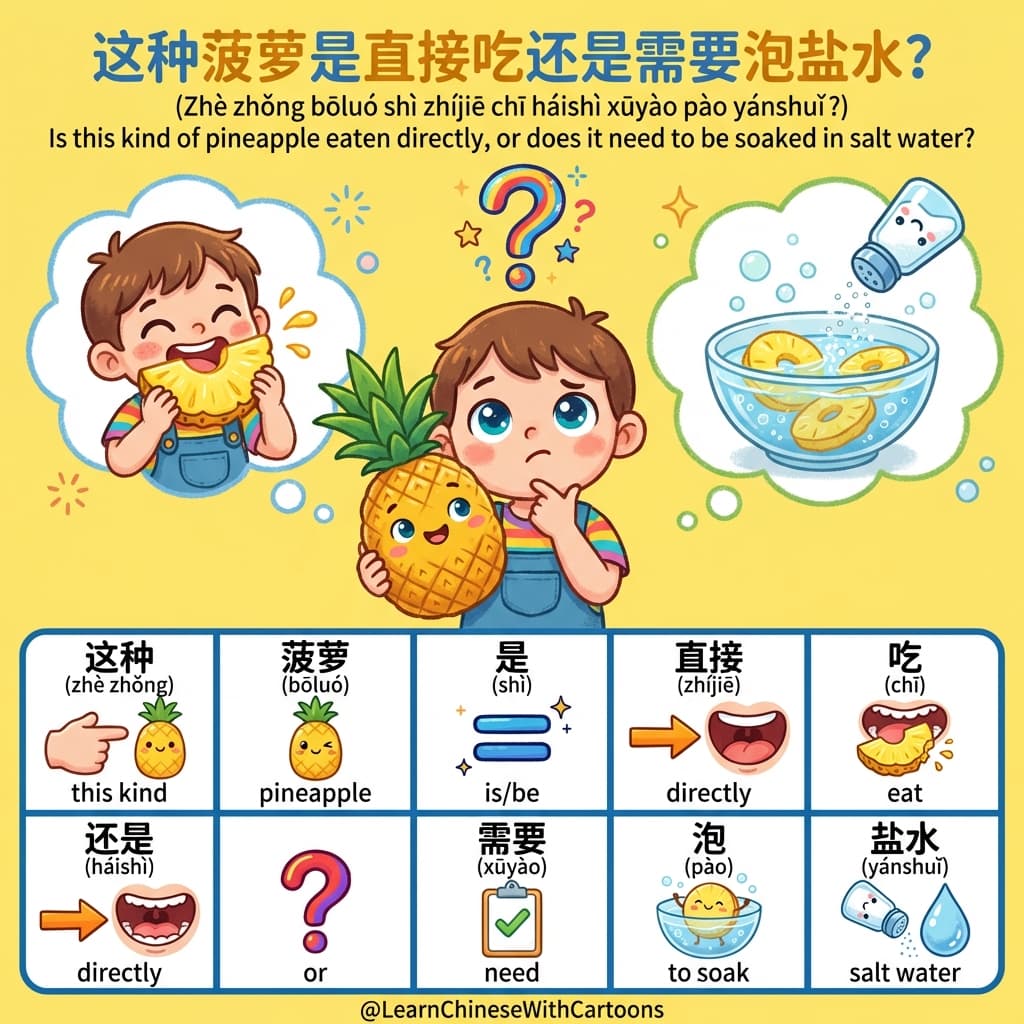
The vendor, an elderly woman with silver hair tied in a neat bun, smiled as Leo approached. She held out a slice of the fruit on a bamboo stick. Leo hesitated. He remembered his last pineapple experience—a sharp, stinging sensation on his tongue that lasted for hours. He needed to be sure. He cleared his throat and asked the question he had practiced all afternoon: 这种菠萝是直接吃还是需要泡盐水?(Zhè zhǒng bōluó shì zhíjiē chī háishì xūyào pào yánshuǐ?)
Key Phrase Breakdown: 这种菠萝是直接吃还是需要泡盐水? (Zhè zhǒng bōluó shì zhíjiē chī háishì xūyào pào yánshuǐ?)
1. 这 (zhè) - This
2. 种 (zhǒng) - Kind / Type
3. 菠萝 (bōluó) - Pineapple
4. 是 (shì) - Is / To be
5. 直接 (zhíjiē) - Directly
6. 吃 (chī) - To eat
7. 还是 (háishì) - Or (used in questions)
8. 需要 (xūyào) - To need
9. 泡 (pào) - To soak
10. 盐水 (yánshuǐ) - Salt water (Salt + Water)
The old woman laughed, a warm sound that blended with the nearby street music. 'Aha! You know the secret!' she said in Mandarin. She pointed to a different pile of fruit. 'Those are common pineapples. But this one? This is the "Honey-Drop" variety.' Leo pointed back at the golden pyramid. 'So... 这种菠萝是直接吃还是需要泡盐水?' he asked again, wanting to be absolutely certain before risking his taste buds.
'这种菠萝是直接吃还是需要泡盐水?' Grandma Mei repeated, mimicking his careful tone with a wink. 'For you, young traveler, I will say: it is so sweet, no salt is needed. It will not bite your tongue.' Just then, a loud tourist from a nearby group bumped into the stall. 'Hey! 这种菠萝是直接吃还是需要泡盐水?' the man shouted, pointing at the same fruit. Grandma Mei gave the man a stern look and replied, 'For him, it's direct. For you, maybe you should wait!'
Leo watched as the woman began to peel a fresh one with incredible speed. He noticed a small wooden sign hand-written in elegant calligraphy resting near the fruit. It read: "请问店主:这种菠萝是直接吃还是需要泡盐水?" (Please ask the owner: Is this pineapple eaten directly or does it need to be soaked in salt water?) It seemed this was the most common question of the night.
Leo took his phone out and sent a voice message to his roommate back in Shanghai. 'Hey man, I'm at the market. I found these amazing pineapples. I had to ask her: 这种菠萝是直接吃还是需要泡盐水? Turns out, these are special!' As he waited for the fruit, he thought about how such a specific sentence could be so vital for a fruit lover in China. Without salt water, a regular pineapple contains bromelain, an enzyme that can cause a stinging sensation. But these "Honey-Drops" were different.
In Chinese, when you want to offer a choice in a question (A or B), you use 还是 (háishì).
Example: 你喝茶还是咖啡? (Nǐ hē chá háishì kāfēi?) [Do you drink tea or coffee?]
It is different from 或者 (huòzhě), which is used for 'or' in statements.
Example: 我喝茶或者咖啡都可以。 (Wǒ hē chá huòzhě kāfēi dōu kěyǐ.) [I can drink either tea or coffee.]
In our main sentence: ...直接吃 (A) 还是 (or) 需要泡盐水 (B)?
This structure is essential for navigating choices in daily life, from ordering food to choosing a path on a hike.
Cultural Corner: Why the Salt Water?
In China, you will often see street vendors selling pineapple chunks floating in large glass jars of water. This isn't just plain water—it's lightly salted. This traditional method helps to break down the bromelain, the enzyme that 'eats' protein and causes that itchy, stinging feeling on your tongue. It also enhances the natural sweetness of the fruit by providing a salty contrast. However, newer 'non-stinging' varieties like the ones Leo found are becoming popular, which is why the question '这种菠萝是直接吃还是需要泡盐水?' is more relevant than ever!
Related Vocabulary
1. 味道 (wèidào) - Taste / Flavor
2. 甜 (tián) - Sweet
3. 酸 (suān) - Sour
4. 削皮 (xiāopí) - To peel (a fruit)
5. 嘴唇 (zuǐchún) - Lips
6. 舌头 (shétou) - Tongue
7. 刺痛 (cìtòng) - Stinging pain
8. 水果店 (shuǐguǒ diàn) - Fruit shop
9. 新鲜 (xīnxiān) - Fresh
10. 推荐 (tuījiàn) - To recommend
Dialogue Practice: At the Fruit Stall
Leo: 你好!请问这个菠萝怎么卖? (Hello! How much is this pineapple?)
Vendor: 十块钱一个,很甜的。 (Ten yuan each, very sweet.)
Leo: 这种菠萝是直接吃还是需要泡盐水? (Is this kind of pineapple eaten directly, or does it need to be soaked in salt water?)
Vendor: 这种是新品种,直接吃就可以,不需要泡。 (This is a new variety, you can eat it directly, no need to soak.)
Leo: 真的吗?不会让舌头不舒服吗? (Really? It won't make my tongue uncomfortable?)
Vendor: 绝对不会,不甜不要钱! (Absolutely not, if it's not sweet, don't pay!)
Leo: 太好了,那请帮我削皮。 (Great, then please help me peel it.)
Vendor: 好的,你要切成小块吗? (Okay, do you want it cut into small pieces?)
Leo: 是的,谢谢。 (Yes, thank you.)
Leo finally took a bite. The juice was like liquid sunshine, bursting with sweetness and without a hint of that dreaded sting. He walked away from the stall, the lights of the night market blurring into a beautiful glow. He realized that sometimes, the best experiences come from knowing exactly how to ask for what you need. As he passed another fruit stand, he heard a fellow expat looking confused at some pineapples. Leo leaned in and whispered, 'Hey, just ask them: 这种菠萝是直接吃还是需要泡盐水? It makes all the difference.'
Lesson Summary & Quiz
Summary: We've learned how to ask about fruit preparation using the 'A 还是 B' structure and explored the cultural reason behind soaking pineapple in salt water.
Quiz:
1. Which word means 'to soak'? (A) 吃 (B) 泡 (C) 削
2. When do you use '还是' (háishì)? (A) In a statement (B) In a question (C) Only for coffee
3. What is 'salt water' in Mandarin? (A) 盐水 (B) 甜水 (C) 汽水
4. Translate 'Directly' into Mandarin: (A) 刚才 (B) 直接 (C) 需要
Answers: 1(B), 2(B), 3(A), 4(B)