The rain in Chengdu doesn't just fall; it whispers. It clings to the grey bricks of the Kuanzhai Alleys, turning the ancient wood of the tea houses into dark, shimmering mirrors. Elara, an expat teacher who had lived in the city for three years but still felt like a ghost haunting its streets, ducked under a low-hanging eaves to escape the downpour.
She found herself in front of a door she had never noticed before. It was small, made of unvarnished cedar, with a simple sign hanging by a rusted chain: 'The Moonlight Tea Stall.'
Pushing the door open, the scent of roasted oolong and old paper washed over her. Behind a counter cluttered with porcelain cups and dried flowers sat a man who looked as though he had been carved from the very wood of the shop. He didn't look up from the small book he was binding.
'Sit,' he said, his voice like gravel. 'The tea is almost ready.'
Elara sat, the dampness of her coat seeping into the bamboo chair. She felt a sudden, strange urge to prove she belonged there, that she wasn't just a lost tourist. She searched her mind for the right words, for a bridge to build between her world and his.
The old man, Mr. Lin, poured a thin stream of amber liquid into a tiny cup. He finally looked up, his eyes twinkling with a kindness that caught Elara off guard. He didn't ask her name. He didn't ask where she was from. Instead, he leaned forward and asked the one question that defines a person’s soul in this quiet corner of the world.
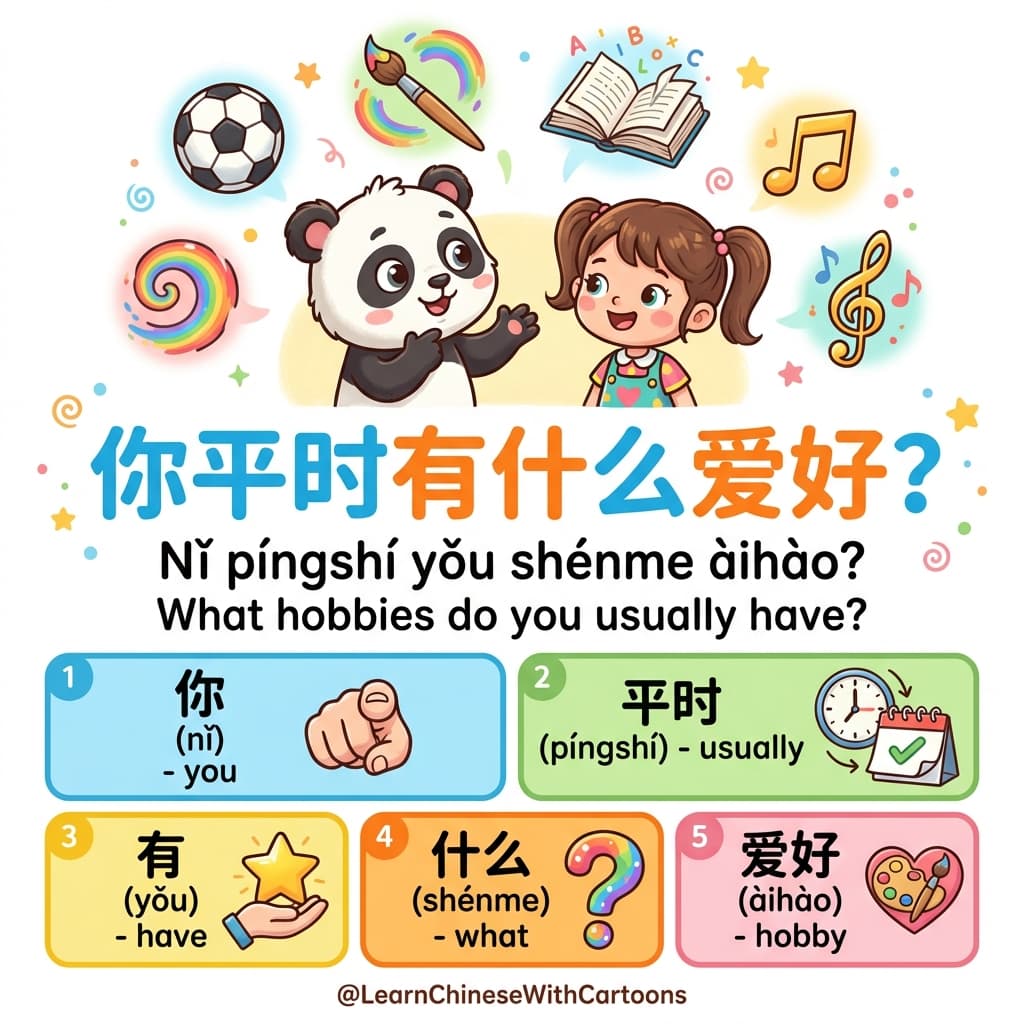
“你平时有什么爱好?” (Nǐ píngshí yǒu shénme àihào?) [What hobbies do you usually have?]
Key Phrase Introduction:
The phrase of the day is 你平时有什么爱好?(Nǐ píngshí yǒu shénme àihào?). This is the quintessential way to ask someone about their interests beyond work or study.
Let's break it down:
• 你 (Nǐ) - You
• 平时 (píngshí) - Usually / In normal times
• 有 (yǒu) - Have
• 什么 (shénme) - What
• 爱好 (àihào) - Hobby / Interest
Tone breakdown:
Nǐ (3rd tone) píng (2nd tone) shí (2nd tone) yǒu (3rd tone) shén (2nd tone) me (neutral) ài (4th tone) hào (4th tone).
Elara froze. It was a simple question, one she had practiced in her first-year Mandarin class, but in this dimly lit room, it felt heavy with meaning.
'I... I used to paint,' she stammered in Chinese. 'But I haven't picked up a brush in years.'
Mr. Lin nodded slowly. 'Hobbies are the breath of the spirit, Elara. Without them, we are just machines walking through the rain.'
As they talked, the door opened again, and a young man with paint-stained fingers entered. He was a regular. He sat beside Elara, and as he shook the water from his umbrella, he turned to her with a friendly grin. 'I'm Chen. I come here to escape the gallery. And you? 你平时有什么爱好?(Nǐ píngshí yǒu shénme àihào?)'
It was the second time the question had been asked, and this time, Elara felt a little less defensive. She told Chen about her love for old architecture, for the way the light hit the curved roofs of the city at sunset.
'That's not just an interest,' Chen laughed. 'That's an eye for beauty. You should come with me to the park on Sunday. There are many elderly people there. If you ask them, “你平时有什么爱好?(Nǐ píngshí yǒu shénme àihào?)”, they won't just tell you they like birds; they will show you a lifetime of devotion to the song of a thrush.'
Elara realized that in her three years here, she had been so focused on 'surviving' the language—ordering food, paying rent, navigating the subway—that she had forgotten to 'live' in the language. She had never stopped to ask her neighbors about their passions.
The next morning, the rain had cleared, leaving the city air crisp. Elara walked to the nearby People's Park. She saw an elderly woman practicing calligraphy with a giant brush dipped in water on the stone pavement.
Elara watched for a long time before gathering her courage. 'Your characters are beautiful,' she said. 'Excuse me, may I ask, 你平时有什么爱好?(Nǐ píngshí yǒu shénme àihào?)'
The woman laughed, the water brush dripping. 'This is it, young lady! Calligraphy is my life. It keeps my heart steady.' She then handed the brush to Elara. 'And you? Besides teaching, 你平时有什么爱好?(Nǐ píngshí yǒu shénme àihào?)'
Elara took the brush. It was heavier than it looked. As she drew a shaky line on the stone, she felt a connection to the pavement, to the park, and to the city that she had never felt before.
Later that evening, Elara sat in a modern cafe, her laptop open, but for once, she wasn't working. She was browsing a local forum for a photography club. A girl sitting at the next table noticed Elara’s camera on the table.
'Is that a Leica?' the girl asked. 'That's a classic! 你平时有什么爱好?(Nǐ píngshí yǒu shénme àihào?) Do you do street photography?'
'I’m starting to,' Elara replied, a genuine smile finally reaching her eyes. 'I’m starting to see the city for the first time.'
The question that had once felt like a textbook exercise had become her key to the city. By asking and being asked, “你平时有什么爱好?(Nǐ píngshí yǒu shénme àihào?)”, Elara had finally stopped being a ghost. She was becoming a part of the story.
Grammar Deep Dive: Using '平时' and '爱好'
1. The Placement of Time: In Chinese, time expressions like 平时 (píngshí - usually/in normal times) typically come after the subject and before the verb.
Example: 我 (Subject) 平时 (Time) 喜欢 (Verb) 喝茶 (Object). [I usually like to drink tea.]
2. '爱好' as a Noun and Verb:
• As a Noun: 你的爱好是什么? (Nǐ de àihào shì shénme?) [What is your hobby?]
• As a Verb: 我很爱好摄影。 (Wǒ hěn àihào shèyǐng.) [I am very fond of photography.] Note: In modern casual speech, 喜欢 (xǐhuan - to like) is more common as a verb, while 爱好 is often used as a noun.
3. The '有' (yǒu) Construction: Using '有' (to have) with '爱好' is the most natural way to ask this question. It implies that a hobby is something you 'possess' as part of your identity.
Cultural Corner: The Concept of 'Aìhào' (爱好) in China
In Western culture, hobbies are often seen as 'leisure activities' or ways to 'decompress.' In China, particularly among the older generation, an 爱好 is often a 'Way' (道 - Dào). Whether it is tea art (茶道), calligraphy (书法), or Tai Chi (太极), these are seen as lifelong journeys of self-improvement.
When you ask an older person in China, “你平时有什么爱好?”, you aren't just making small talk. You are inviting them to share their philosophy of life. Don't be surprised if the answer involves a deep explanation of balance, nature, and discipline! For the younger generation, hobbies like 'Glamping,' 'City Walk,' and 'Photography' have become the new social currency, helping people find their 'tribes' in the massive urban jungles.
Related Vocabulary: Expand Your Horizons
1. 摄影 (shèyǐng) - Photography
2. 远足 (yuǎnzú) - Hiking
3. 烹饪 (pēngrèn) - Cooking
4. 弹钢琴 (tán gāngqín) - Playing the piano
5. 健身 (jiànshēn) - Working out / Fitness
6. 旅游 (lǚyóu) - Traveling
7. 收藏 (shōucáng) - Collecting (stamps, art, etc.)
8. 逛街 (guàngjiē) - Shopping / Window shopping
9. 刷剧 (shuājù) - Binge-watching shows
10. 下棋 (xiàqí) - Playing chess
Dialogue Practice: At the Social Mixer
A: 你好!我是王明。很高兴认识你。 (Nǐhǎo! Wǒ shì Wáng Míng. Hěn gāoxìng rènshi nǐ.) [Hello! I am Wang Ming. Nice to meet you.]
B: 你好,王明。我叫大卫。你是本地人吗? (Nǐhǎo, Wáng Míng. Wǒ jiào Dàwèi. Nǐ shì běndìrén ma?) [Hello, Wang Ming. My name is David. Are you a local?]
A: 是的,我是成都人。大卫,你平时有什么爱好? (Shì de, wǒ shì Chéngdū rén. Dàwèi, nǐ píngshí yǒu shénme àihào?) [Yes, I am from Chengdu. David, what hobbies do you usually have?]
B: 我平时喜欢远足和摄影。你呢? (Wǒ píngshí xǐhuan yuǎnzú hé shèyǐng. Nǐ ne?) [I usually like hiking and photography. And you?]
A: 我对烹饪很有兴趣。我喜欢做川菜。 (Wǒ duì pēngrèn hěn yǒu xìngqù. Wǒ xǐhuan zuò Chuāncài.) [I am very interested in cooking. I like making Sichuan food.]
B: 太好了!川菜很好吃,但是有点辣。 (Tài hǎole! Chuāncài hěn hǎochī, dànshì yǒudiǎn là.) [Great! Sichuan food is delicious, but a bit spicy.]
A: 没错。你觉得摄影难吗? (Méicuò. Nǐ juéde shèyǐng nán ma?) [Correct. Do you think photography is difficult?]
B: 不难,但是需要很多练习。 (Bù nán, dànshì xūyào hěnduō liànxí.) [Not hard, but it requires a lot of practice.]
A: 有机会的话,我们可以一起去公园拍照! (Yǒu jīhuì de huà, wǒmen kěyǐ yìqǐ qù gōngyuán pāizhào!) [If there is a chance, we can go to the park together to take photos!]
B: 一言为定! (Yì yán wéi dìng!) [It's a deal!]
Lesson Summary & Quiz
Today we learned how to pierce through the surface of small talk using the phrase: 你平时有什么爱好?(Nǐ píngshí yǒu shénme àihào?).
Key Takeaways:
1. '平时' (píngshí) indicates 'usually' and is placed after the subject.
2. '爱好' (àihào) can be a noun (hobby) or a verb (to be fond of).
3. The answer structure is usually: 我平时喜欢 [Activity].
Quick Quiz:
1. How do you say 'Usually' in Chinese?
A) 经常 (jīngcháng)
B) 平时 (píngshí)
C) 时候 (shíhou)
2. Which word means 'Photography'?
A) 摄影 (shèyǐng)
B) 旅游 (lǚyóu)
C) 健身 (jiànshēn)
3. Translate: 'What is your hobby?' (Noun form)
A) 你喜欢什么?
B) 你的爱好是什么?
C) 你做什么?
(Answers: 1:B, 2:A, 3:B)