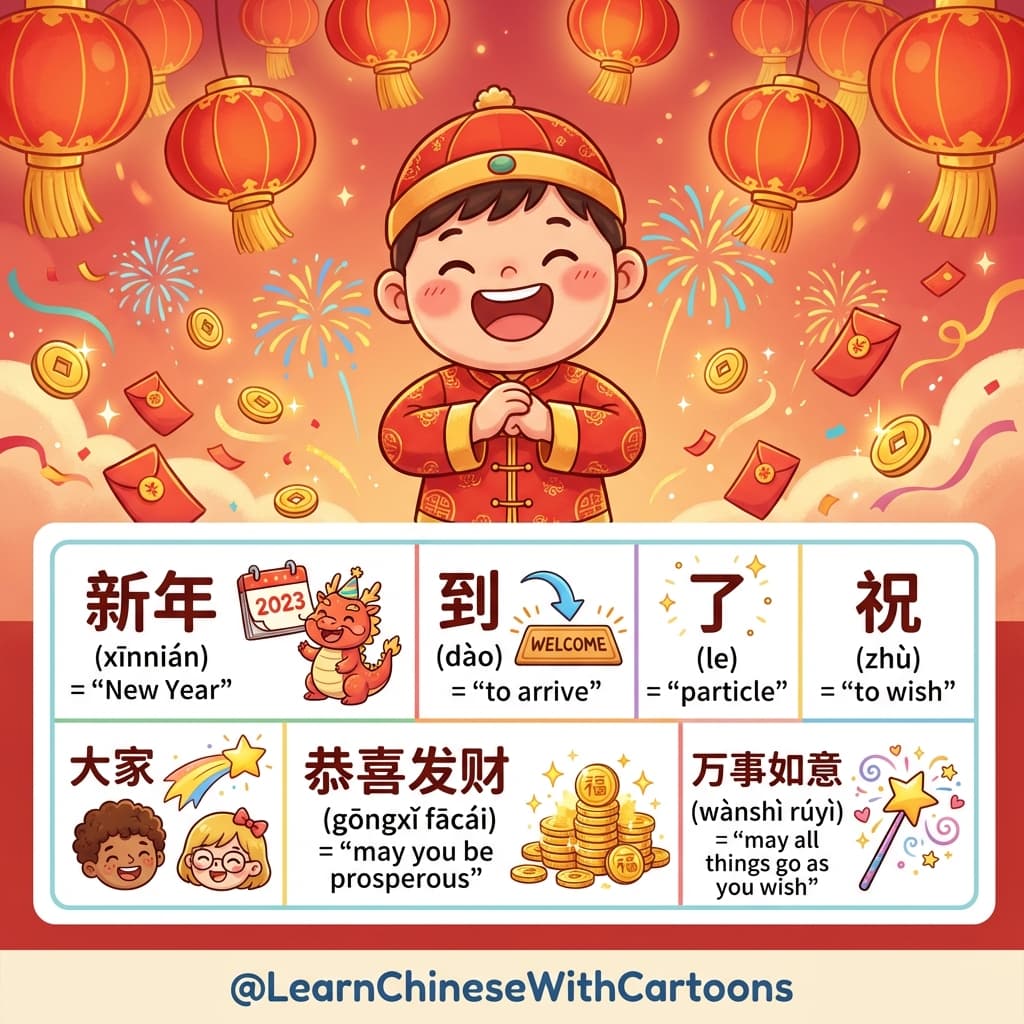
The air in the high Yunnan mountains was so cold it felt brittle, like thin glass waiting to shatter. Leo, a freelance photographer from London, pulled his scarf tighter as he navigated the narrow, cobblestone streets of Shigu Village. It was the eve of the Lunar New Year, and the village was undergoing a transformation. The usual grey stone walls were being draped in vibrant crimson. Huge red lanterns swayed from wooden eaves, casting a warm, flickering glow onto the light dusting of snow.
Leo felt a bit like a ghost in this bustling preparation. He had his camera, but his tongue felt heavy with the few Mandarin words he had practiced. Just as he was about to turn back to his guesthouse, a shopkeeper burst out of a small storefront, clutching a stack of red envelopes. He looked at the sky, then at the gathering crowd, and let out a joyous shout: “新年到了,祝大家恭喜发财,万事如意!” (Xīnnián dào le, zhù dàjiā gōngxǐ fācái, wànshì rúyì!)
The crowd erupted in cheers. It was the first time Leo had heard the phrase in the wild—not just from an app, but as a living, breathing force of joy. He realized that if he wanted to capture the heart of this festival, he couldn’t just take photos; he had to join the conversation.
The Key Phrase: A Multi-Layered Blessing
Before we continue Leo's journey, let’s break down this powerful sentence. This is the 'Swiss Army Knife' of New Year greetings. It covers everything: timing, well-wishes, wealth, and general happiness.
1. 新年到了 (Xīnnián dào le): New Year has arrived. (新年 = New Year; 到了 = Arrived/Is here)
2. 祝大家 (zhù dàjiā): Wish everyone. (祝 = to wish; 大家 = everyone)
3. 恭喜发财 (gōngxǐ fācái): May you be prosperous/Congratulations on your wealth.
4. 万事如意 (wànshì rúyì): May everything go as you wish. (万事 = ten thousand things/everything; 如意 = as one wishes/according to your will)
The Story Continues: The Gift of the Scroll
Leo ducked into a small paper-cutting shop where an elderly woman was teaching children how to cut intricate patterns into red paper. She looked up and smiled at Leo’s camera. Taking a leap of faith, Leo bowed slightly and practiced his pronunciation: “新年到了,祝大家恭喜发财,万事如意!” (Xīnnián dào le, zhù dàjiā gōngxǐ fācái, wànshì rúyì!)
The grandmother’s face lit up. She handed him a small piece of paper shaped like a fish—a symbol of abundance. “Very good!” she said in Mandarin. She then invited him to join her family for the 'Reunion Dinner' (Tuán yuán fàn). As the family gathered around a steaming hot pot, the father raised a glass of rice wine. He looked at Leo and then at his children, repeating the blessing: “新年到了,祝大家恭喜发财,万事如意!”
During the meal, a small child, no more than five years old, tugged at Leo’s sleeve. He was holding his hands together in a respectful cupping gesture. “Uncle,” he whispered, “新年到了,祝大家恭喜发财,万事如意!” Leo knew what this meant—the child was politely asking for a 'Hongbao' (red envelope). Luckily, the grandmother had slipped Leo a few earlier. He handed one to the boy, who ran off giggling.
After dinner, they moved to the village square. A large calligraphy scroll was being prepared on a long table. The village elder dipped a large brush into black ink. With a flourish, he wrote the very characters Leo had been learning. He turned to the crowd and shouted one last time before the fireworks began: “新年到了,祝大家恭喜发财,万事如意!”
As the first explosions of color lit up the mountain sky, Leo pulled out his phone. He recorded a quick video for his followers back home, his voice filled with newfound confidence. “Hey everyone,” he said, “新年到了,祝大家恭喜发财,万事如意! I think I finally understand what this season is about.”
Grammar Deep Dive
Let's look at two important grammatical features in this phrase:
1. The 'Change of State' (了 - le): In '新年到了' (Xīnnián dào le), the '了' is not just past tense. It signifies a change in the situation. It wasn't the New Year before, but now it has arrived. You can use this for many things, like '下雨了' (Xià yǔ le - It’s started raining).
2. The Wish Structure (祝 + Person + Blessing): This is the standard way to offer a blessing. You can replace '大家' (everyone) with any person. For example: '祝你...' (Zhù nǐ... - Wish you...). It is followed by a four-character idiom (Chengyu), which makes the greeting sound formal and poetic.
Cultural Corner: Prosperity and Wishes
Why 'Gongxi Facai'? In Western cultures, we usually wish for 'happiness.' In Chinese culture, wishing someone wealth (发财 - fācái) is considered a very practical and sincere way to show you care about their well-being. If someone has wealth, they can support their family and live a stable life. 'Wanshi Ruyi' (Everything as you wish) covers the spiritual side—hoping that your heart’s desires come true without obstacles.
Related Vocabulary
1. 春节 (Chūnjié) - Spring Festival / Lunar New Year
2. 红包 (hóngbāo) - Red envelope (containing money)
3. 饺子 (jiǎozi) - Dumplings
4. 烟花 (yānhuā) - Fireworks
5. 团圆 (tuányuán) - Reunion (especially family)
6. 拜年 (bàinián) - To pay a New Year call / give greetings
7. 对联 (duìlián) - Spring festival couplets (red scrolls on doors)
8. 灯笼 (dēnglóng) - Lantern
9. 桔子 (júzi) - Tangerines (symbol of luck)
10. 除夕 (chúxī) - Lunar New Year's Eve
Dialogue Practice
Leo (L) is helping Auntie Li (AL) prepare the table.
L: 阿姨,这个灯笼挂在哪儿? (Āyí, zhège dēnglóng guà zài nǎ'er?)
[Auntie, where should I hang this lantern?]
AL: 挂在大门两边吧,这样漂亮。 (Guà zài dàmén liǎngbiān ba, zhèyàng piàoliang.)
[Hang it on both sides of the main door; it looks beautiful that way.]
L: 好的。今天要放烟花吗? (Hǎo de. Jīntiān yào fàng yānhuā ma?)
[Okay. Are we setting off fireworks today?]
AL: 当然!半夜十二点我们一起放。 (Dāngrán! Bànyè shí'èr diǎn wǒmen yīqǐ fàng.)
[Of course! We will set them off together at midnight.]
L: 我已经准备好了我的相机。 (Wǒ yǐjīng zhǔnbèi hǎo le wǒ de xiàngjī.)
[I have already prepared my camera.]
AL: 别只顾着拍照,记得吃饺子。 (Bié zhǐ gùzhe pāizhào, jìde chī jiǎozi.)
[Don't just focus on taking photos; remember to eat dumplings.]
L: 我会吃很多的!新年到了,我也要祝你们家快乐。 (Wǒ huì chī hěnduō de! Xīnnián dào le, wǒ yě yào zhù nǐmen jiā kuàilè.)
[I will eat a lot! New Year has arrived, I also want to wish your family happiness.]
AL: 谢谢你,小李。祝你万事如意! (Xièxiè nǐ, Xiǎo Lǐ. Zhù nǐ wànshì rúyì!)
[Thank you, Little Lee. Wish you everything goes as you wish!]
Lesson Summary & Quiz
Today we learned the quintessential New Year blessing: 新年到了,祝大家恭喜发财,万事如意! This phrase is your golden ticket to participating in Lunar New Year celebrations anywhere in the world.
Quick Quiz:
1. What does '万事如意' mean literally?
2. Why do we use '了' in '新年到了'?
3. What is the traditional gift given to children after they say a New Year blessing?
4. How do you say 'Fireworks' in Mandarin?
5. Write the Pinyin for 'Wish everyone'.
(Answers: 1. Ten thousand things as you wish. 2. To indicate a change of state/arrival. 3. A Red Envelope/Hongbao. 4. 烟花 (Yānhuā). 5. Zhù dàjiā.)