The silver-gray clouds had been looming over the jagged skyline of Chongqing all morning, but Leo was too distracted by the spicy aroma of a hidden noodle shop to notice. As a language student from London, Leo had spent the last three months exploring the 'Mountain City,' yet he still found himself constantly surprised by its sudden shifts in mood. One moment, the sun would be glinting off the Yangtze River; the next, a heavy mist would swallow the skyscrapers whole.
He sat at a small, wobbly wooden table tucked under a red awning. Just as he lifted a chopstick full of 'Dan Dan' noodles, a low rumble of thunder vibrated through the ground. The old woman who ran the stall, Auntie Chen, wiped her hands on her apron and looked up at the sky. She sighed, her eyes narrowing as the first heavy droplets began to splatter against the pavement.
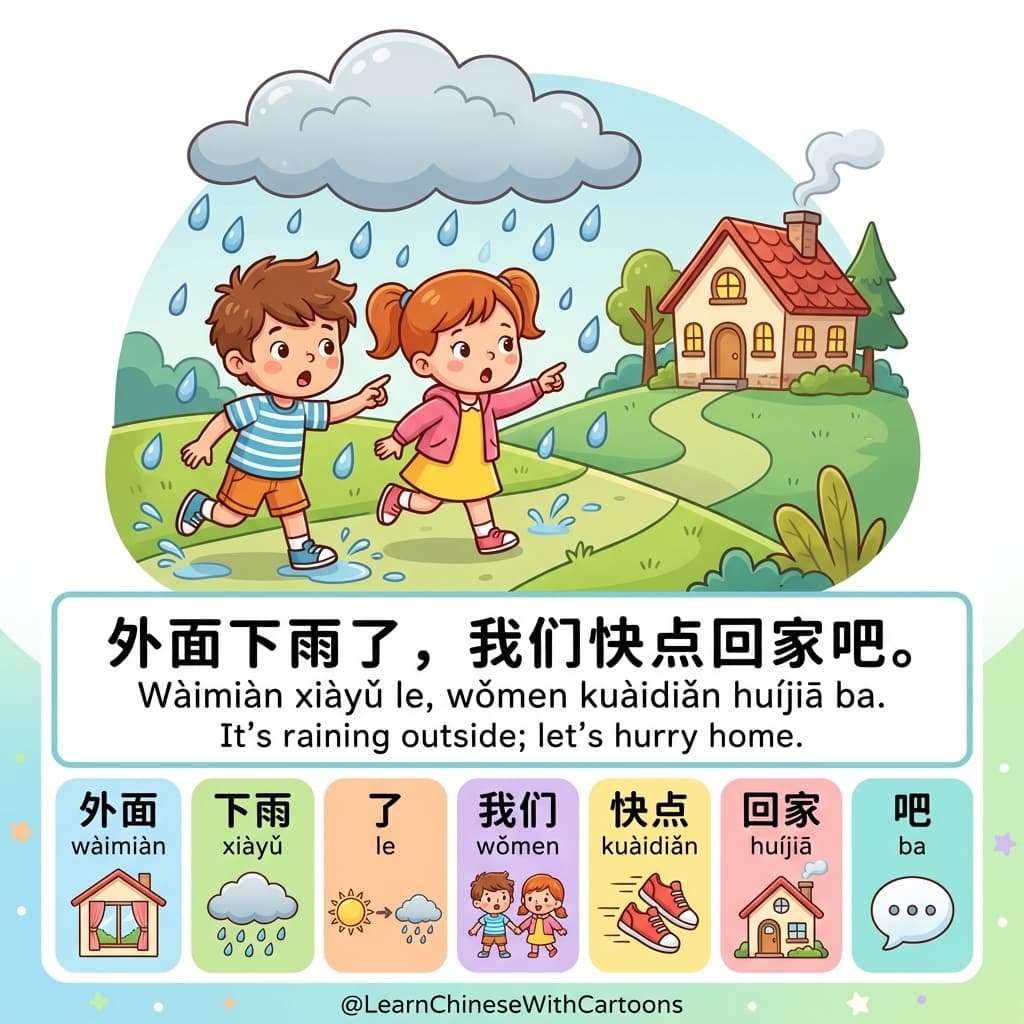
'小伙子,外面下雨了,我们快点回家吧。' (Xiǎohuǒzi, wàimiàn xiàyǔ le, wǒmen kuàidiǎn huíjiā ba.) [Young man, it's raining outside; let's hurry home.]
The Essential Phrase: 外面下雨了,我们快点回家吧。
Before we dive deeper into Leo’s rainy adventure, let’s break down this vital sentence. In China, weather isn't just a topic for small talk; it’s a shared experience that often leads to acts of kindness and community.
1. 外面 (Wàimiàn) - Outside. 'Wài' means outer, and 'miàn' means side or surface.
2. 下雨 (Xiàyǔ) - To rain. 'Xià' means to fall/down, and 'yǔ' means rain.
3. 了 (le) - A particle indicating a change of state (It wasn't raining, but now it is!).
4. 我们 (Wǒmen) - We/Us.
5. 快点 (Kuàidiǎn) - Hurry up / A bit faster. 'Kuài' means fast, and 'diǎn' (short for yīdiǎn) means a little bit.
6. 回家 (Huíjiā) - To go home. 'Huí' means return, and 'jiā' means home or family.
7. 吧 (ba) - A suggestion particle used at the end of a sentence to make it sound softer and more polite.
The Story Continues: The Sudden Downpour
Leo looked at the darkening street. He hadn't brought an umbrella, and his apartment was a twenty-minute walk uphill through a maze of stone staircases. He paid for his noodles quickly, but as he stepped out from under the awning, the drizzle turned into a torrential wall of water. He retreated back into the stall, bumping into a young woman who was also seeking shelter. She was clutching a soggy bag of groceries and looking at her phone anxiously.
'外面下雨了,我们快点回家吧。' (Wàimiàn xiàyǔ le, wǒmen kuàidiǎn huíjiā ba.) [It's raining outside; let's hurry home.] Leo heard her whisper to herself, perhaps repeating a mental mantra or imagining what her mother would say to her right now. It was a phrase that echoed throughout the city whenever the clouds broke.
Suddenly, a bus screeched to a halt nearby. A group of school children scrambled off, their bright yellow backpacks covered in plastic. One boy tripped, and his friend helped him up, shouting, '外面下雨了,我们快点回家吧!' (Wàimiàn xiàyǔ le, wǒmen kuàidiǎn huíjiā ba!) [It's raining outside; let's hurry home!] Their laughter cut through the sound of the rain, turning a gloomy moment into a game of tag against the elements.
Leo realized he couldn't wait forever. He saw a small convenience store across the street and decided to make a run for it. Just as he was about to dash, Auntie Chen grabbed his arm and handed him a sturdy, albeit slightly faded, blue umbrella. '拿去吧,' (Ná qù ba - Take it,) she said. '外面下雨了,我们快点回家吧。' (Wàimiàn xiàyǔ le, wǒmen kuàidiǎn huíjiā ba.) [It's raining outside; let's hurry home.] She waved off his offer to pay for it, insisting he return it another day.
Walking through the rain-slicked streets of Chongqing, Leo felt a strange sense of belonging. The neon signs reflected in the puddles—red, green, and gold—creating a kaleidoscope beneath his feet. He passed a couple huddled under a single tiny umbrella. The man was soaking wet on one side because he was holding the umbrella over the woman. He leaned in and said softly, '外面下雨了,我们快点回家吧。' (Wàimiàn xiàyǔ le, wǒmen kuàidiǎn huíjiā ba.) [It's raining outside; let's hurry home.] It wasn't just a suggestion; it was an expression of care.
As Leo finally reached the heavy iron gates of his apartment complex, his phone buzzed. It was a message from his roommate, Zhang Wei: '外面下雨了,我们快点回家吧。我已经做了热汤。' (Wàimiàn xiàyǔ le, wǒmen kuàidiǎn huíjiā ba. Wǒ yǐjīng zuòle rè tāng.) [It's raining outside; let's hurry home. I've already made hot soup.] Leo smiled, shook out the blue umbrella, and stepped inside, feeling the warmth of the city even on its coldest, wettest day.
Grammar Deep Dive: The Power of 'Ba' and 'Le'
This phrase is a masterclass in natural Chinese sentence structure. Let’s look at two key elements:
1. The 'Change of State' 了 (le):
In the phrase '下雨了' (xiàyǔ le), the 'le' isn't about the past tense. Instead, it indicates that the situation has changed. It wasn't raining before, but now it is. This is crucial for weather: '天阴了' (Tiān yīn le - It has become cloudy) or '大风了' (Dàfēng le - It has become windy).
2. The Suggestive 吧 (ba):
Without 'ba', the sentence '我们回家' (Wǒmen huíjiā) sounds like a flat statement: 'We are going home.' By adding 'ba', you turn it into a suggestion or an invitation. It invites the other person to agree with you, making the tone much friendlier. In Chinese culture, making suggestions rather than giving orders is a key part of 'polite' speech.
Cultural Corner: The Concept of 'Home' (家) in China
In the West, 'home' is often seen as a private sanctuary. In China, the character 家 (jiā) represents a pig under a roof—symbolizing ancestral security and sustenance. When someone says 'Let's go home' during a rainstorm, they aren't just talking about a building. They are talking about returning to a place of safety, warmth, and family. Sharing an umbrella or offering a ride home during 'xià yǔ' (rain) is one of the most common ways Chinese people show 'guānxī' (care/connection).
Related Vocabulary
1. 雨伞 (yǔsǎn) - Umbrella (Character: 雨 sǎn)
2. 湿 (shī) - Wet/Moist
3. 淋湿 (lín shī) - To get soaked/drenched
4. 闪电 (shǎndiàn) - Lightning
5. 打雷 (dǎléi) - To thunder
6. 乌云 (wūyún) - Dark clouds
7. 避雨 (bì yǔ) - To take shelter from the rain
8. 温暖 (wēnnuǎn) - Warm/Cozy
9. 赶紧 (gǎnjǐn) - Hurriedly/Quickly
10. 落 (luò) - To fall (as in rain drops falling)
Dialogue Practice: Caught in the Storm
(A is a student, B is a friend standing at the school gate)
A: 你看天空,好黑啊。 (Nǐ kàn tiānkōng, hǎo hēi a.) [Look at the sky, it's so dark.]
B: 好像要下雨了。 (Hǎoxiàng yào xiàyǔ le.) [It looks like it's going to rain.]
A: 糟了,我没带伞。 (Zāo le, wǒ méi dài sǎn.) [Oh no, I didn't bring an umbrella.]
B: 别担心,我有大伞。 (Bié dānxīn, wǒ yǒu dà sǎn.) [Don't worry, I have a big umbrella.]
A: (Rain starts falling) 哎呀!雨落下来了。 (Āiyā! Yǔ luò xiàlái le.) [Gosh! The rain is falling.]
B: 外面下雨了,我们快点回家吧。 (Wàimiàn xiàyǔ le, wǒmen kuàidiǎn huíjiā ba.) [It's raining outside; let's hurry home.]
A: 好的,我们走吧。路很滑,小心点。 (Hǎo de, wǒmen zǒu ba. Lù hěn huá, xiǎoxīn diǎn.) [Okay, let's go. The road is slippery, be careful.]
B: 没关系,我们打一辆出租车吧。 (Méiguānxì, wǒmen dǎ yī liàng chūzūchē ba.) [It's okay, let's hail a taxi.]
Lesson Summary & Quiz
Today we learned how to express urgency and care during a weather change. Remember: 'Le' for the change, 'Ba' for the suggestion!
Quiz:
1. How do you say 'Outside' in Mandarin?
a) Inside (Nèimiàn)
b) Outside (Wàimiàn)
c) Left side (Zuǒbiān)
2. What does the particle 'Ba' (吧) do at the end of a sentence?
a) Makes it a question
b) Indicates past tense
c) Makes it a suggestion
3. Translate: 'Hurry up!'
a) Kuàidiǎn (快点)
b) Màndiǎn (慢点)
c) Huíjiā (回家)
(Answers: 1:b, 2:c, 3:a)