The Silence of the Red Planet
The red dust of Mars rattled against the reinforced hull of the Star-Seeker 9 like skeletal fingers. Inside the cockpit, the only light came from the flickering console and a small, glowing holographic projector. Lin sat alone, her breath hitching in the thin artificial air. Millions of miles away, on a blue marble she could barely see through the telescope, her life was waiting.
She touched the hologram. It showed a bustling kitchen in Chengdu, steam rising from a pot of spicy broth, her father laughing as he flipped dough, her mother meticulously grading papers at the table, and her younger brother trying to sneak a piece of meat. In the cold, metallic vacuum of space, this memory was her only fuel.
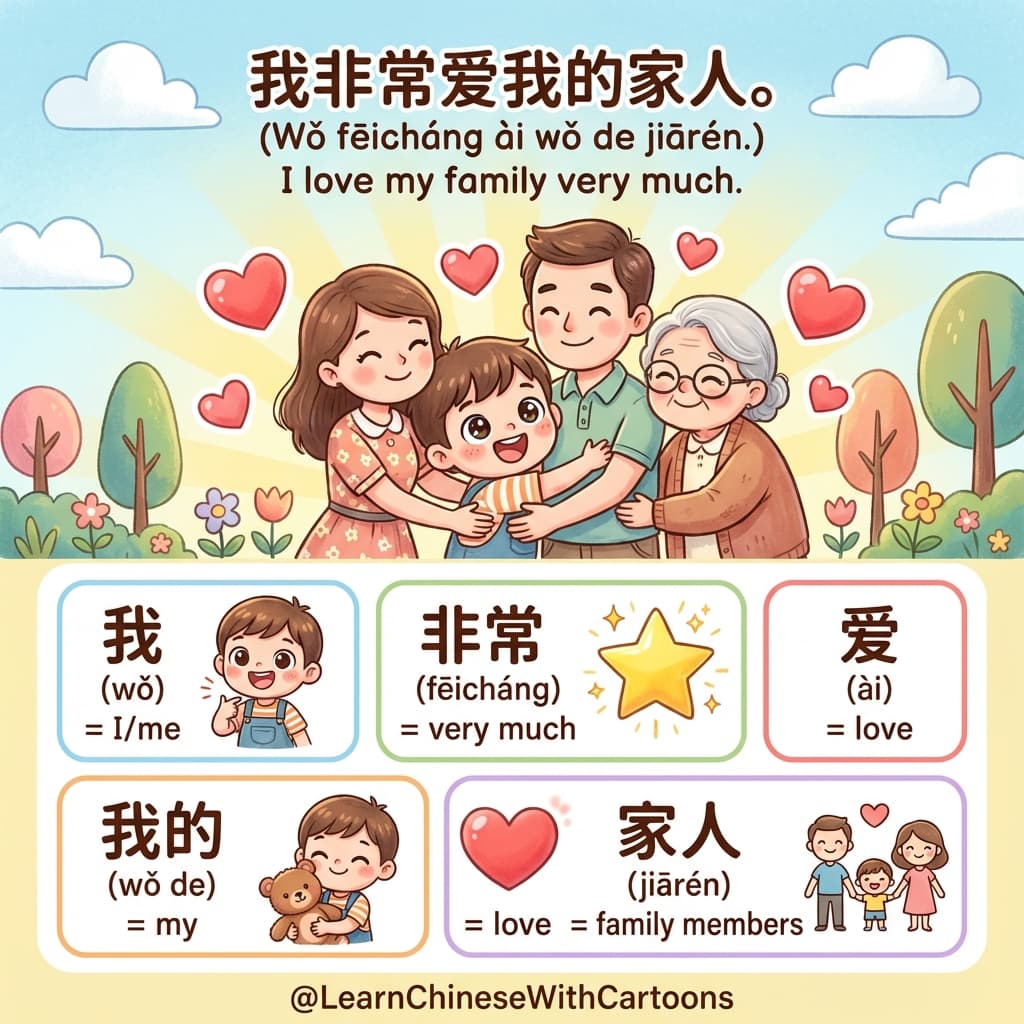
Lin whispered a phrase she had repeated every night since leaving Earth. It wasn't a command for the ship or a technical report. It was a promise: "我非常爱我的家人。" (Wǒ fēicháng ài wǒ de jiārén.) [I love my family very much.]
Key Phrase Introduction
Today, we are learning a sentence that captures the core of Chinese culture: the love of family. Whether you are far away from home like Lin or sitting at the dinner table with your loved ones, this phrase is essential for expressing deep affection.
Phrase: 我非常爱我的家人。
Pinyin: Wǒ fēicháng ài wǒ de jiārén.
Translation: I love my family very much.
Word-by-Word Breakdown
To truly understand the weight of this sentence, let’s look at its building blocks:
1. 我 (wǒ) — I / Me
2. 非常 (fēicháng) — Very / Extremely / Exceptionally
3. 爱 (ài) — To love
4. 我的 (wǒ de) — My (The 'de' makes it possessive)
5. 家人 (jiārén) — Family members (Literally: House/Home + Person)
The Story Continues: Echoes from Home
The ship’s AI, a soft voice named Spark, chimed in. "Oxygen levels at forty percent, Commander Lin. You should rest."
Lin didn't move. She pulled out her physical journal—a rare luxury in space. On the first page, she had written in bold ink: "我非常爱我的家人。" (Wǒ fēicháng ài wǒ de jiārén.) [I love my family very much.] She looked at the date. It was the Lunar New Year back on Earth.
She closed her eyes and could almost smell the Sichuan peppercorns. She remembered the year she told them she was accepted into the space program. Her father had been silent for a long time, his hands covered in flour. Finally, he had hugged her, his voice trembling. "Go," he had said. "We are your roots, but you are the branch that reaches the stars."
Lin opened her terminal to record a message, though she knew it might not reach Earth for weeks. "Dad, Mom, Xiao Peng... I’m looking at the stars, but I’m thinking of you. I hope you know that 我非常爱我的家人。" (Wǒ fēicháng ài wǒ de jiārén.) [I love my family very much.]
Suddenly, a warning siren blared. A solar flare was approaching, threatening to knock out the communication array. Lin sprang into action. As she recalibrated the shields, her hands shook. She thought of her mother’s resilience when the family had lost their first shop. Her mother never gave up. Neither would Lin.
"Spark, reroute all auxiliary power to the comms!" she shouted.
"Commander, that will leave the cabin freezing," Spark warned.
"I don't care," Lin gritted her teeth. "I have to send this message. Because 我非常爱我的家人。" (Wǒ fēicháng ài wǒ de jiārén.) [I love my family very much.]
The power surged. The ship groaned. For a moment, the connection flickered green. On the screen, a grainy video started to play—a pre-recorded message from home. It was her brother, Xiao Peng. "Sister, we made your favorite dumplings today. We left a chair empty for you. Come back soon. We love you."
Lin’s tears floated in the zero-gravity cabin, tiny crystal spheres of emotion. "I will," she whispered. "我非常爱我的家人。" (Wǒ fēicháng ài wǒ de jiārén.) [I love my family very much.]
Hours later, after the flare passed and the ship stabilized, Lin sat in the quiet. She realized that space wasn't empty as long as she carried those words with her. She looked at the camera one last time before the long sleep for the journey back. "Just remember," she smiled at the lens, "我非常爱我的家人。" (Wǒ fēicháng ài wǒ de jiārén.) [I love my family very much.]
Grammar Deep Dive: The Power of "非常" and "的"
1. Using Adverbs of Degree: 非常 (fēicháng)
In Chinese, "很" (hěn) is the most common way to say "very," but it is often used just to link a subject and an adjective. To show intense, emotional emphasis—the kind Lin feels in deep space—we use "非常" (fēicháng). It literally means "not ordinary."
Example: 我很爱他们 (I love them) vs. 我非常爱他们 (I love them exceptionally/very much).
2. The Possessive "的" (de)
This tiny particle is the "apostrophe-s" of Chinese.
我 (I) + 的 (de) = 我的 (My/Mine)
你 (You) + 的 (de) = 你的 (Your/Yours)
Note: In some very close relationships, like "my mother" (我妈妈), you can drop the "的," but keeping it in "我的家人" makes it feel a bit more formal and emphasizing the personal connection.
3. "家" vs "家人"
家 (jiā) can mean "house" or "home."
家人 (jiārén) specifically refers to the people inside the home—your family members.
So, you love your "jiārén," but you return to your "jiā."
Cultural Corner: The Architecture of Family
The Chinese character for family, 家 (jiā), is fascinating. It consists of two parts:
Top: 宀 (mián), the radical for "roof."
Bottom: 豕 (shǐ), an ancient character for "pig."
In ancient China, a house was only considered a "home" if there was livestock under the roof—representing prosperity, food, and stability. Today, while most Chinese families don't keep pigs in the living room, the sentiment remains: family is the foundation of survival and happiness.
The concept of 孝 (xiào), or filial piety, is the backbone of society. It’s the respect and care for one's parents and ancestors. When Lin says she loves her family, she isn't just expressing a feeling; she is acknowledging a lifelong bond and a duty to return home.
Related Vocabulary
Expand your emotional range with these 10 related words:
1. 父母 (fùmǔ) — Parents
2. 兄弟姐妹 (xiōngdì jiěmèi) — Siblings
3. 团圆 (tuányuán) — To reunite / Reunion
4. 思念 (sīniàn) — To miss / To long for
5. 照顾 (zhàogù) — To take care of
6. 幸福 (xìngfú) — Happiness / Blessed
7. 支持 (zhīchí) — Support
8. 温暖 (wēnnuǎn) — Warmth / Warm
9. 保护 (bǎohù) — To protect
10. 家乡 (jiāxiāng) — Hometown
Dialogue Practice: A Message Across the Stars
Lin is finally connected to her brother, Xiao Peng, via a live-lag video link.
Xiao Peng: 姐姐,你听得到吗? (Jiějiě, nǐ tīng dé dào ma?) [Sister, can you hear me?]
Lin: 听得到!看到你真高兴。 (Tīng dé dào! Kàndào nǐ zhēn gāoxìng.) [I can! It's so good to see you.]
Xiao Peng: 妈妈每天都为你担心。 (Māma měitiān dū wèi nǐ dānxīn.) [Mom worries about you every day.]
Lin: 告诉她我很好。别担心。 (Gàosù tā wǒ hěn hǎo. Bié dānxīn.) [Tell her I’m fine. Don’t worry.]
Xiao Peng: 我们都在等你回家吃年夜饭。 (Wǒmen dū zài děng nǐ huí jiā chī niányèfàn.) [We are all waiting for you to come home for New Year's Eve dinner.]
Lin: 我也非常想念妈妈做的饭。 (Wǒ yě fēicháng xiǎngniàn māma zuò de fàn.) [I also really miss the food Mom makes.]
Xiao Peng: 姐姐,我们都很爱你。 (Jiějiě, wǒmen dōu hěn ài nǐ.) [Sister, we all love you very much.]
Lin: 我知道。我非常爱我的家人。 (Wǒ zhīdào. Wǒ fēicháng ài wǒ de jiārén.) [I know. I love my family very much.]
Story Conclusion
One year later, the Star-Seeker 9 capsule splashed down in the Pacific Ocean. When the hatch opened, the air was salty and thick with humidity—nothing like the sterile recycled air of Mars. As Lin was wheeled onto the recovery ship, she saw three figures standing by the railing, waving frantically.
She didn't wait for the doctors. She stood up, her legs wobbly from a year in zero-G, and walked toward them. Her father's hair was a bit whiter, her brother was taller, and her mother was already crying.
As they embraced, Lin didn't need a holographic projector or a journal anymore. She whispered the words into her mother's ear, feeling the solid, physical reality of home. "I'm back," she said. "And 我非常爱我的家人。" (Wǒ fēicháng ài wǒ de jiārén.) [I love my family very much.]
Lesson Summary & Quiz
You've followed Lin from the stars back to Chengdu. Now, let’s see what you’ve learned!
Summary:
- "非常" (fēicháng) adds strong emphasis.
- "家人" (jiārén) refers to your family members.
- "的" (de) is the key to possessive nouns.
Quick Quiz:
1. How do you say "My family" in Chinese?
A) 我的家 (Wǒ de jiā)
B) 我的家人 (Wǒ de jiārén)
C) 我家人 (Wǒ jiārén)
D) Both B and C
2. Which word means "extremely/very"?
A) 非常 (fēicháng)
B) 爱 (ài)
C) 家 (jiā)
3. Fill in the blank: 我非常___我的家人。
A) 谁 (shuí)
B) 爱 (ài)
C) 去 (qù)
(Answers: 1: D, 2: A, 3: B)