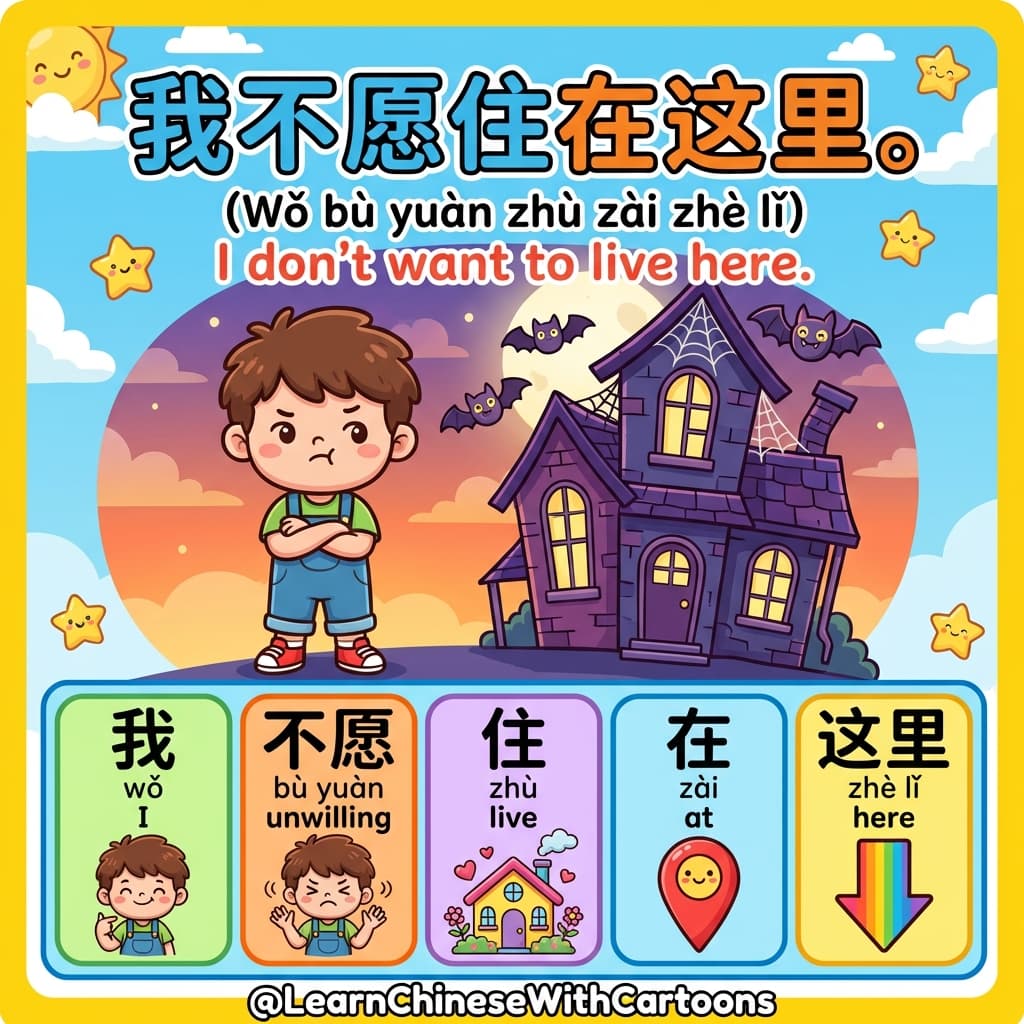
The clock towers of Wùchéng (雾城 - Fog City) did not strike hours; they struck cycles of silence. Lin sat on her cold stone windowsill, watching the grey mist swallow the streetlamps. There was no birdsong here, only the low hum of the massive gears that turned deep beneath the cobblestones, keeping the city afloat in a sea of eternal clouds. To the elders, this was safety. To the Warden, this was order. But to Lin, it was a beautiful cage. She pressed her forehead against the glass and whispered the thought that had become her morning prayer: '我不愿住在这里。' (Wǒ bù yuàn zhù zài zhè lǐ.) [I don't want to live here.]
Key Phrase: 我不愿住在这里。
(Wǒ bù yuàn zhù zài zhè lǐ.) - 'I don't want to live here.' / 'I am unwilling to live here.'
Word-by-Word Breakdown:
1. 我 (Wǒ) - I / me [3rd tone]
2. 不 (bù) - Not [4th tone]
3. 愿 (yuàn) - Wish / Willing / Desire (Short for 愿意 - yuàn yì) [4th tone]
4. 住 (zhù) - To live / To reside [4th tone]
5. 在 (zài) - At / In / Located at [4th tone]
6. 这 (zhè) - This [4th tone]
7. 里 (lǐ) - Inside / Place (这里 - zhè lǐ together means 'here') [3rd tone]
The Story Continues: The Echoes of a Cold City
Every citizen in Wùchéng wore a grey coat, a grey hat, and a grey expression. They were told that the world outside the fog was a chaotic mess of burning heat and freezing storms. 'Safety is the absence of color,' the Warden would say. Lin, however, had found an old book in her grandfather’s workshop. It was filled with sketches of things called 'trees' and 'sunsets.' The colors in the book made her heart ache. When her grandmother asked her to prepare for the annual Silence Festival, Lin shook her head. '奶奶,我不愿住在这里。' (Nǎinai, wǒ bù yuàn zhù zài zhè lǐ.) [Grandma, I don't want to live here.] her voice was small, but steady.
Her grandmother gasped, dropping a silver gear. 'Hush, child! The sensors will hear you.' But Lin didn't care. She spent her days at the city gates, watching the mechanical scouts return from the 'Outside.' They were often covered in green residue—crushed leaves that smelled of life. One afternoon, a scout dropped a small, vibrant red petal. Lin picked it up, hiding it in her palm. As the Warden approached to inspect the gate, he saw the defiance in her eyes. He asked her if she was satisfied with the city's peace. Lin looked at the grey horizon and said clearly, '我不愿住在这里。' (Wǒ bù yuàn zhù zài zhè lǐ.) [I don't want to live here.] The Warden’s eyes narrowed, but he said nothing. He didn't understand 'unwillingness.' In this city, everyone was supposed to be a gear in the machine.
That night, Lin packed a small bag. She didn't take much—just her grandfather's book, the red petal, and a compass. She wrote a note to her neighbors, those who spent their lives polishing the brass of their cages. It was a simple note: '我不愿住在这里。' (Wǒ bù yuàn zhù zài zhè lǐ.) [I don't want to live here.] She left it on her kitchen table, a final signature of her identity. She climbed the maintenance ladder toward the ventilation ducts, the only path that led past the fog-walls. The air was thin and smelled of copper. Every step she took, she reminded herself of her purpose. She wasn't running away; she was running toward. As she reached the final hatch, she looked back at the dim, flickering lights of the city. For the fifth time, she confirmed her soul's truth: '我不愿住在这里。' (Wǒ bù yuàn zhù zài zhè lǐ.) [I don't want to live here.]
The hatch groaned as it opened. A blast of warm, fragrant air hit her face. It didn't smell like fog or oil; it smelled like rain on hot earth. She stepped out onto a cliffside, and for the first time in her life, she saw the moon. It wasn't grey. It was a silver pearl against a velvet sky. She began to walk down the mountain path, leaving the mechanical hum behind. When the first rays of the sun began to turn the sky orange and gold, she turned one last time toward the disappearing fog of Wùchéng. With a smile that reached her eyes, she whispered to the wind, '我不愿住在这里。' (Wǒ bù yuàn zhù zài zhè lǐ.) [I don't want to live here.] And she never did again.
Grammar Deep Dive: Unpacking Desire and Location
1. The Power of '愿' (yuàn) vs '想' (xiǎng)
In our key phrase, Lin uses '不愿' (bù yuàn). You might already know '不想' (bù xiǎng), which also means 'don't want.' However, '愿' (from 愿意 - yuàn yì) carries a much deeper sense of willingness and soul-level consent. '不想' is often used for simple desires (e.g., 'I don't want to eat bread'). '不愿' implies a refusal or a lack of willingness to accept a situation. It is more formal and more emotional.
2. Using '在' (zài) to Indicate Location
In Chinese, '在' (zài) acts like a bridge between the action and the place. The structure is usually: [Subject] + [Action] + [在] + [Location]. In our phrase, '住' (live) is the action, and '这里' (here) is the location. Note that in Chinese, we often place the location *before* the verb in many contexts (我在家吃饭 - I at home eat), but with '住' (to live), it is very common to see '住在...' (living at...).
- 这里 (zhè lǐ): Here
- 那里 (nà lǐ): There
- 哪里 (nǎ lǐ): Where?
Always check the tone of 'na'! 3rd tone (nǎ) is for questions, 4th tone (nà) is for 'that/there.'
Cultural Corner: The Concept of 'Home' (家 - jiā)
In Chinese culture, '家' (jiā) represents more than just a house; it represents family, lineage, and belonging. The radical at the top of '家' (宀) represents a roof, and the bottom part (豕) represents a pig—symbolizing prosperity and a settled life. For Lin to say '我不愿住在这里' is a radical statement because it rejects the 'safety' and 'prosperity' that her society provides in favor of a spiritual 'home' she hasn't even found yet. In modern China, the tension between the safety of the hometown and the 'dream' of the big city is a very common theme in literature and film.
Related Vocabulary: Expanding Your World
1. 自由 (zì yóu) - Freedom
2. 逃离 (táo lí) - To escape / To flee
3. 离开 (lí kāi) - To leave / To depart
4. 城市 (chéng shì) - City
5. 雾 (wù) - Fog / Mist
6. 阳光 (yáng guāng) - Sunlight
7. 危险 (wēi xiǎn) - Dangerous / Danger
8. 选择 (xuǎn zé) - To choose / Choice
9. 沉默 (chén mò) - Silence / Silent
10. 永远 (yǒng yuǎn) - Forever / Eternal
Dialogue Practice: A Grandmother's Plea
奶奶 (Nǎinai): 林,你在做什么?(Lín, nǐ zài zuò shén me?) [Lin, what are you doing?]
林 (Lín): 我在收拾行李。(Wǒ zài shōu shi xíng li.) [I am packing my bags.]
奶奶 (Nǎinai): 为什么?雾城很安全。(Wèi shén me? Wùchéng hěn ān quán.) [Why? Fog City is very safe.]
林 (Lín): 我不愿住在这里。(Wǒ bù yuàn zhù zài zhè lǐ.) [I don't want to live here.]
奶奶 (Nǎinai): 外面的世界很危险。(Wài miàn de shì jiè hěn wēi xiǎn.) [The world outside is dangerous.]
林 (Lín): 也许,但我需要阳光。(Yě xǔ, dàn wǒ xū yào yáng guāng.) [Perhaps, but I need sunlight.]
奶奶 (Nǎinai): 你会后悔吗?(Nǐ huì hòu huǐ ma?) [Will you regret it?]
林 (Lín): 我不知道,但我必须走。(Wǒ bù zhī dào, dàn wǒ bì xū zǒu.) [I don't know, but I must go.]
Conclusion & Quiz
Lin's journey reminds us that 'living' is more than just occupying a space. It requires a willingness to be where you are. When you learn a new language, you aren't just learning words; you are learning to express your deepest desires and choices. Let's see how much you've learned from Lin's escape!
1. What does '愿' (yuàn) specifically imply compared to '想' (xiǎng)?
2. Translate: '我不愿离开。'
3. How do you say 'sunlight' in Chinese?
4. What is the difference between '这里' and '哪里'?
5. In the phrase '住在城市里', what does '在' do?
(Answers: 1. Deep willingness/desire. 2. I don't want to leave. 3. 阳光 - yáng guāng. 4. Here vs. Where. 5. It marks the location after the verb.)