The rain in Shanghai didn’t just fall; it orchestrated a symphony against the floor-to-ceiling windows of the 'Cloud & Ink' cafe. Leo, a freelance translator from Canada, sat nestled in a velvet armchair, the neon lights of the Bund blurring into a kaleidoscope of blue and pink outside. He was only three paragraphs away from finishing a high-stakes contract. The cursor blinked rhythmically, a tiny heartbeat on his screen. Then, without warning, the rhythm stopped. The screen flickered, turned a sickly shade of grey, and vanished into total darkness.
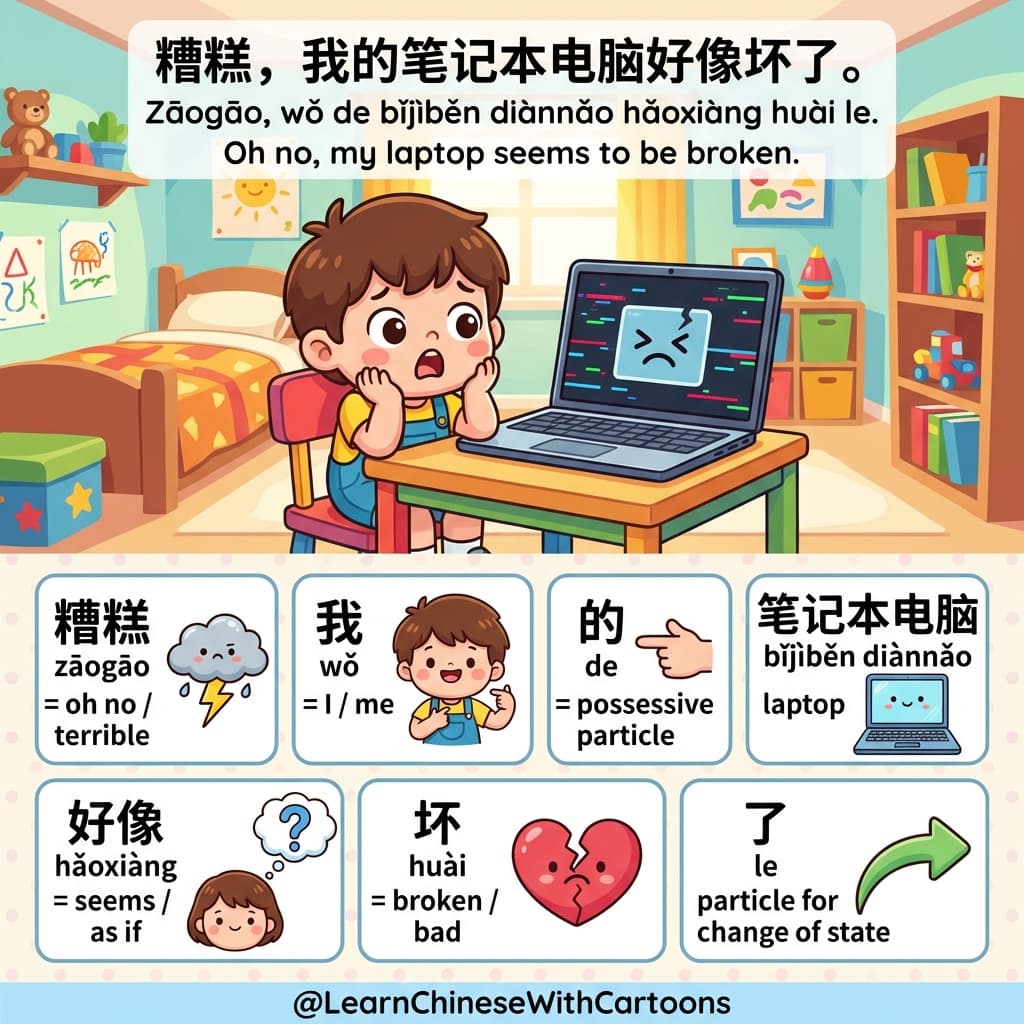
Leo gasped, his heart dropping into his stomach. He pressed the power button—nothing. He held it down—still nothing. Panic, cold and sharp, set in. He whispered to the empty air: "糟糕,我的笔记本电脑好像坏了。" (Zāogāo, wǒ de bǐjìběn diànnǎo hǎoxiàng huài le.) [Oh no, my laptop seems to be broken.]
The Key Phrase: 糟糕,我的笔记本电脑好像坏了。
Before we dive deeper into Leo's digital nightmare, let’s look at the anatomy of this extremely useful sentence:
1. 糟糕 (zāogāo) — Oh no / Terrible / A mess
2. 我的 (wǒ de) — My
3. 笔记本电脑 (bǐjìběn diànnǎo) — Laptop (literally: notebook electric-brain)
4. 好像 (hǎoxiàng) — Seems / appears to be
5. 坏了 (huài le) — Broken / went bad
Leo didn’t have time for a crisis. The deadline was at midnight. He stood up abruptly, nearly knocking over his cold matcha latte. A waitress approached, looking concerned. "先生,你没事吧?" (Xiānsheng, nǐ méishì ba? - Sir, are you okay?)
Leo gestured frantically to the dead machine on the table. "糟糕,我的笔记本电脑好像坏了。" (Zāogāo, wǒ de bǐjìběn diànnǎo hǎoxiàng huài le.) [Oh no, my laptop seems to be broken.]
"别担心," (Bié dānxīn - Don't worry,) she said, pointing toward a narrow alleyway across the street. "Go to 'Old Wang’s Tech Clinic.' If he can’t fix it, no one can."
Leo dashed out into the rain, shielding the laptop under his coat like a precious infant. He burst into a tiny shop packed to the ceiling with wires, motherboards, and the smell of ozone. An old man with thick glasses looked up.
"师傅,帮帮我!" (Shīfu, bāng bāng wǒ! - Master, help me!) Leo cried. "糟糕,我的笔记本电脑好像坏了。" (Zāogāo, wǒ de bǐjìběn diànnǎo hǎoxiàng huài le.) [Oh no, my laptop seems to be broken.]
Old Wang took the device, turning it over in his calloused hands. "什么时候坏的?" (Shénme shíhòu huài de? - When did it break?)
Leo paced the small shop, muttering to himself in a daze, "刚才还在用,突然就黑屏了。糟糕,我的笔记本电脑好像坏了。" (Gāngcái hái zài yòng, tūrán jiù hēi píng le. Zāogāo, wǒ de bǐjìběn diànnǎo hǎoxiàng huài le.) [I was just using it, then suddenly the screen went black. Oh no, my laptop seems to be broken.]
His phone rang. It was his editor, Sarah. Leo answered with a shaky voice. "Sarah, I have bad news. 糟糕,我的笔记本电脑好像坏了。" (Sarah, wǒ yǒu huài xiāoxī. Zāogāo, wǒ de bǐjìběn diànnǎo hǎoxiàng huài le.) [Sarah, I have bad news. Oh no, my laptop seems to be broken.]
Sarah’s voice was stern. "Leo, that file is due in two hours! How did this happen?"
"I don't know!" Leo lamented, looking at Old Wang who was now poking at the laptop’s internal battery with a multimeter. "糟糕,我的笔记本电脑好像坏了,而且我还没保存最后的修改!" (Zāogāo, wǒ de bǐjìběn diànnǎo hǎoxiàng huài le, érqiě wǒ hái méiyǒu bǎocún zuìhòu de xiūgǎi!) [Oh no, my laptop seems to be broken, and I haven't even saved the last edits!]
Grammar Deep Dive: Using '好像' (hǎoxiàng) and '坏了' (huài le)
1. The Power of 好像 (hǎoxiàng):
In Chinese, '好像' is used to express uncertainty or a hunch. It softens the statement. Instead of saying "My laptop IS broken," saying "It SEEMS to be broken" sounds more natural when you aren't a technician yourself.
Example: 他好像不高兴。(Tā hǎoxiàng bù gāoxìng.) — He seems unhappy.
2. Understanding 坏了 (huài le):
'坏' (huài) means bad, spoiled, or broken. The '了' (le) indicates a change of state—it wasn't broken before, but it is now. You can use '坏了' for anything from a broken phone to rotten apples or a malfunctioning elevator.
Example: 电梯坏了。(Diàntī huài le.) — The elevator is broken.